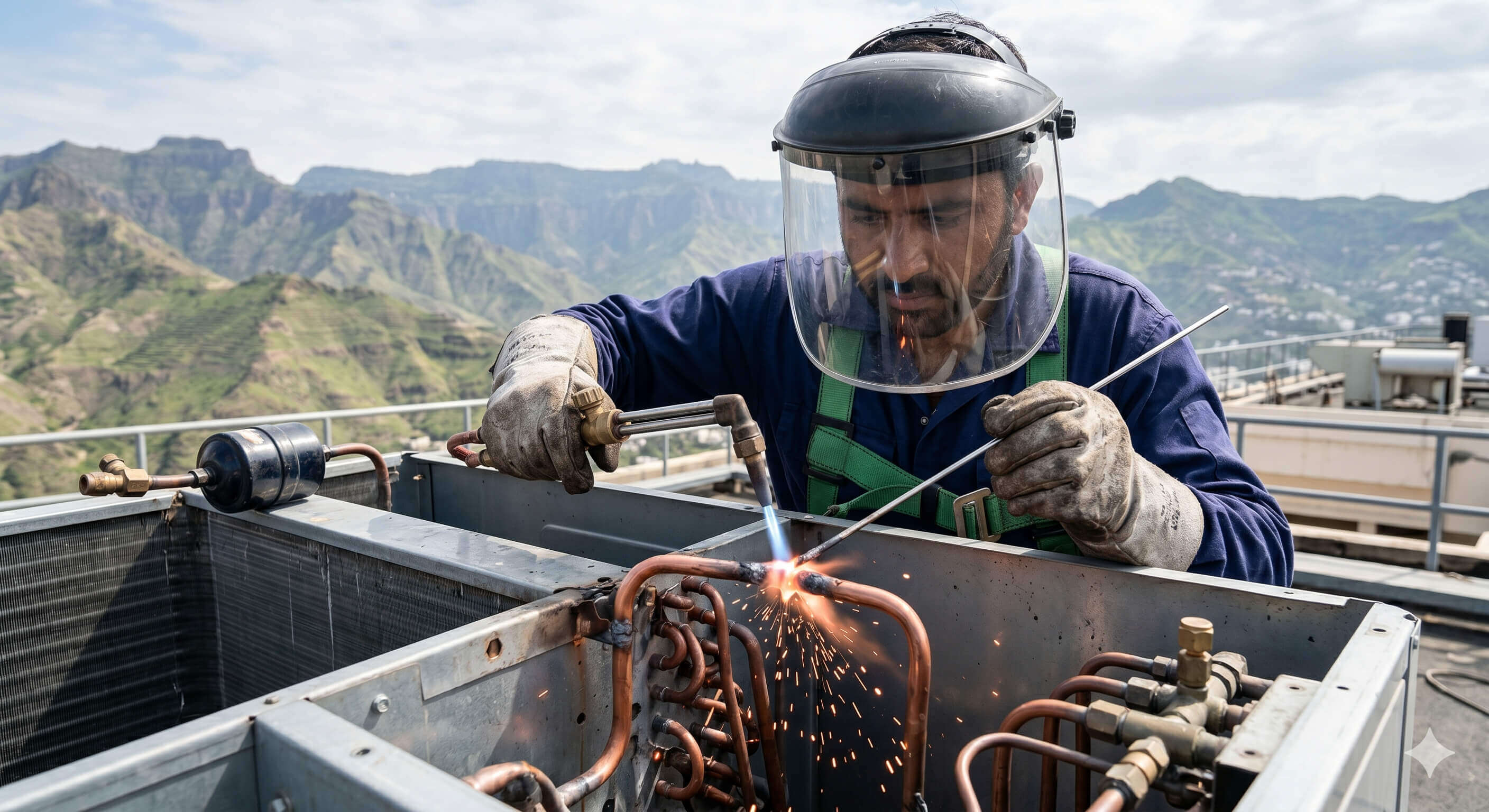
Charging refrigerant in Abha is technically different from charging it in Jazan — altitude affects refrigerant system pressures. Standard pressure gauges give correct values at sea level, but in Abha we need additional adjustment to guarantee the correct charge amount.
Why Gas Charging Differs in Abha
The technical principle: operating pressure is linked to ambient air density. At 2,200m, atmospheric pressure is approximately 23% lower than at sea level. This shifts the normal operating pressure values for the refrigerant circuit. A technician charging gas in Abha using sea-level values overcharges the system, which stresses the compressor long-term.
Signs of Low Refrigerant
Weaker cooling than usual — especially at peak heat
Indoor coil occasionally freezing
Room taking much longer than normal to reach set temperature
Outdoor unit running hotter than usual
Faint hissing sound near the outdoor unit
Frequently Asked Questions
How often does an AC need a gas refill?
A sound refrigerant system never needs routine refilling. If your gas level drops every season, there is a leak that needs repairing.
Can different refrigerant types be mixed?
Never. Mixing refrigerant types destroys the compressor and voids the manufacturer warranty. Old gas must be fully recovered before charging a different type.
What does a gas refill cost?
SAR 150–350 depending on type and quantity. R22 is more expensive than R410A due to scarcity.
Why did the refrigerant get low in the first place?
Because there's a leak. An AC is a sealed circuit and refrigerant is not consumed. Any technician offering a 'top-up' without finding the leak is selling you a temporary fix. We find and repair the leak first, then charge.
How do you know the correct amount?
We don't charge by feel, or by pressure alone. We use a manifold to read suction and discharge pressures, and calculate superheat and subcooling against the manufacturer's table. A correct charge is a calculated figure, not an estimate.
Is overcharging better than undercharging?
No — it can be worse. An overcharge raises discharge pressure, strains the compressor, and can return liquid refrigerant to it, which breaks it mechanically. Both under and overcharging are harmful; correct is what's needed.
What refrigerant does my AC use?
It's printed on the data plate of the outdoor unit. Most modern units in the Saudi market use R-410A or R-32. Types must never be mixed or swapped without modification — the pressures and oils are different.
How often should an AC need a recharge?
Never. A healthy AC needs no refrigerant added across its entire life. If you need a recharge every season, you aren't buying gas — you're paying for a leak nobody fixed.
Can low refrigerant destroy the compressor?
Yes. The suction gas returning from the coil is what cools the compressor windings internally. On a low charge the compressor runs hot, its insulation degrades, and eventually it burns out. That's why we don't recommend running a unit you know is low.
Refrigerant Types Used in the Region
Most AC units in the Saudi market use one of two main refrigerants. R410A is the standard in units manufactured after 2010 — chlorine-free, ozone-safe, and operating at higher pressures than R22. R22 is found in older units and its global production has ceased, meaning prices have climbed and availability has dropped. If your unit runs on R22, every refill will cost more than before — a good time to consider upgrading to a unit that uses R410A. Some newer inverter models use R32, which requires a technician familiar with its specific properties, as it is classified as mildly flammable and requires particular handling precautions.
How We Handle Gas Refills in Abha Differently
At 2,200 metres above sea level, atmospheric pressure in Abha is approximately 77 kPa compared to 101 kPa at sea level — a 23% difference. This directly affects the normal operating pressure readings for a refrigeration system.
A technician trained at sea level knows from experience what pressure values look "normal." Using those same numbers in Abha, the gauge will read low due to the reduced atmospheric pressure — leading the technician to overcharge the system. Overcharging puts excess stress on the compressor and accelerates wear, often not noticed until a season or two later. Our team adjusts pressure reference values for each city's elevation and uses calibrated digital manifold gauges rather than traditional analog dials.
When Low Refrigerant Means There Is a Leak
A properly sealed refrigeration system does not lose gas. Refrigerant is not consumed like fuel — it circulates in a closed loop indefinitely if there is no leak. If your AC needs a refill every season or two, that is a clear sign of a leak. Topping up the gas without fixing the leak is throwing money away. Common leak causes in this region include: corrosion at copper fittings (especially in coastal Jazan), cracked evaporator coils from repeated thermal stress cycles, and loose connections from rushed installations. We run a nitrogen or electronic leak test before any refill if the history suggests recurring loss.
Cost of Refill vs. Cost of Neglect
Many customers delay a refrigerant refill because cooling is "still acceptable." The problem is that a compressor running low on refrigerant operates at higher-than-designed temperatures. Every hour of operation in this state degrades the compressor oil and weakens internal windings. A refrigerant refill costs 150–350 SAR. A compressor replacement costs 800–2,000 SAR. The maths consistently favour preventive action.
How Abha, Khamis Mushait and Jazan Differ in Refill Needs
Three cities, three very different environments — each affecting how refrigerant is lost. Abha and Khamis Mushait: units run hard for 5–6 summer months then rest. This seasonal on-off cycle causes expansion and contraction at fittings, gradually opening micro-leaks over time. Jazan: units run nearly year-round, but coastal salinity and humidity accelerate external corrosion of copper fittings — a different threat mechanism but no less serious. Our technicians understand the failure patterns specific to each city and look for them proactively during every visit.
Does your AC need attention?
Call us now for a free assessment and instant quote