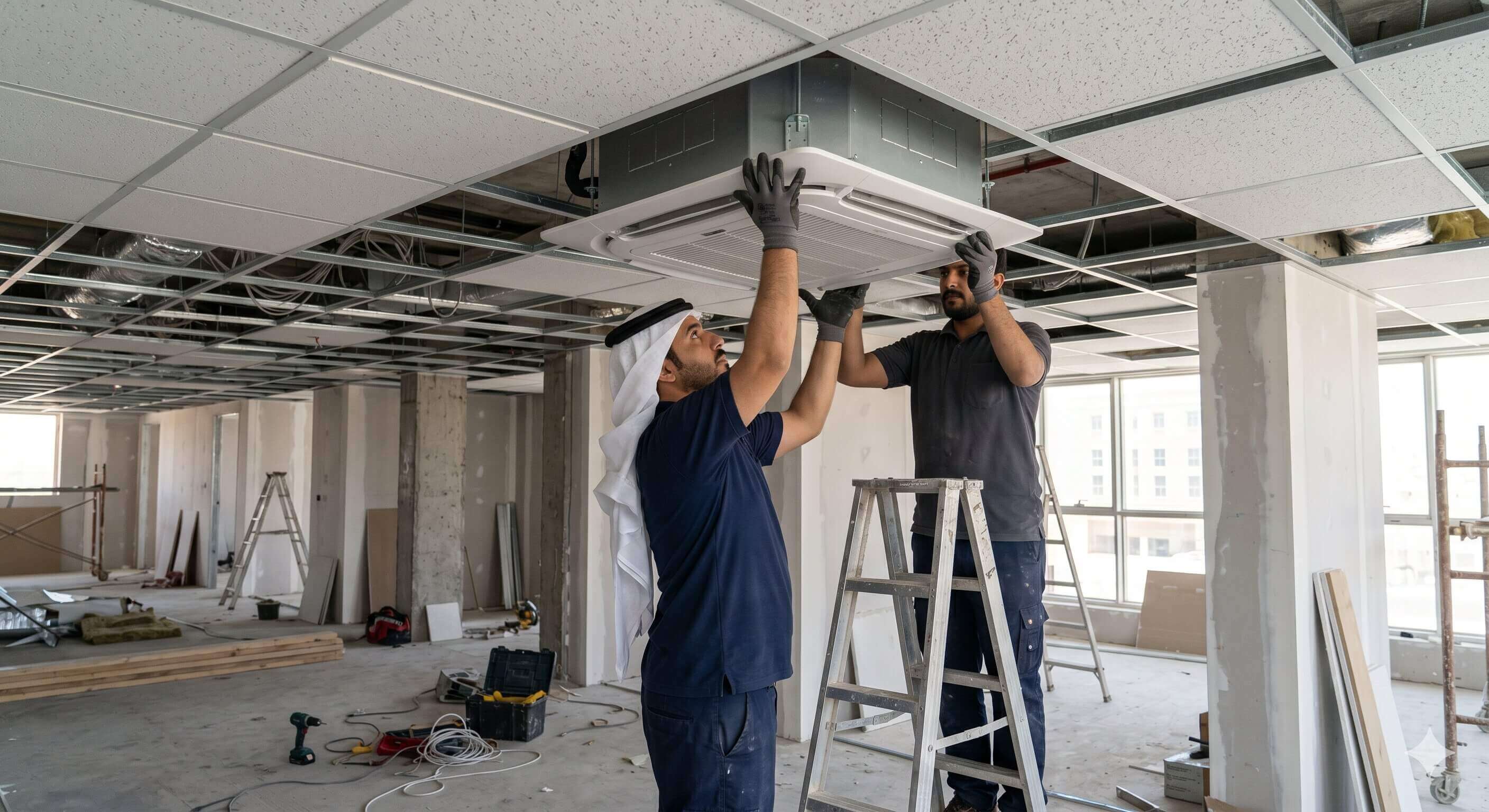
A cassette AC is installed flush in the false ceiling and distributes air in four directions from its centre. Ideal for offices and open commercial spaces that a wall-mounted split cannot cover effectively.
When to Choose Cassette Over Split
Factor
Wall Split
Ceiling Cassette
Ideal coverage
20–40 sqm
30–80 sqm
Air distribution
One or two directions
Four equal directions
Aesthetics
Visible on wall
Integrated in ceiling
Maintenance
Easy access
Requires ceiling access
Cost
Lower
30–50% higher
Professional Cassette Installation Steps
1. Identifying the Optimal Position
Must be centred in the space for even distribution. If the space is very rectangular, two units or a larger capacity may be needed to cover both ends.
2. Selecting the Correct Capacity
In Jazan, the cassette needs 20–25% higher capacity due to the additional humidity load — otherwise it will run continuously without achieving required comfort.
3. Routing the Condensate Pump and Pipe
The cassette has an internal condensate pump that lifts water to the drain pipe. In Jazan, the pipe must be designed for higher flow volume (twice Abha's typical rate) to handle the large condensate volume.
4. Secure Ceiling Mounting
A cassette weighs 20–30kg. It is mounted on strong metal brackets attached to the actual ceiling structure, not just plasterboard. Weak mounting causes vibration and noise over time.
Cassette in the Regional Climate — What Differs
Khamis Mushait: Choose an Inverter cassette to avoid repeated short cycles in the long, hot summer
Jazan: Confirm the condensate pump has adequate capacity — excess condensate will overwhelm an undersized pump
Abha: In offices with ceilings above 3m, verify the air throw specification is sufficient to reach the occupied level
Frequently Asked Questions
How many cassette units does a 100sqm office in Khamis Mushait need?
With peak summer load and office occupants, a 100sqm office typically needs 2 cassettes at 2–2.5 ton each, or one large 5-ton cassette depending on the layout.
Can each cassette unit be controlled independently?
Yes — each cassette has its own remote or control panel. In VRF systems with multiple cassettes, either centralised or independent per-unit control is available.
Is a false ceiling mandatory for cassette installation?
A false ceiling makes installation much easier but is not mandatory. The cassette can be recessed into a concrete ceiling but requires drilling and restricts maintenance access options.
What matters most when installing a cassette unit?
The drain line and its pump. A ceiling cassette gets no help from gravity, so any error in the line's fall or in the pump means water inside your ceiling rather than outside it. That's the difference between a good install and one that costs you a ceiling.
Why are cassettes preferred in offices and shops?
Because they distribute air in four directions from the centre of the ceiling, giving more even coverage in open spaces than a wall-mounted split. They also take up no wall space.
Does a cassette need a false ceiling?
In practice yes — it's designed to be recessed into a ceiling void of sufficient depth. Before committing to a cassette we verify the available void height, because not every ceiling can take one.
Does a cassette always need a condensate pump?
In most cases yes, because the unit sits in the ceiling and can't rely on gravity to drain. The exception is where there's a sufficient natural fall to a drain point — which is rare in practice in residential installations.
How much ceiling void do I need?
It depends on the model, but the void must accommodate the unit's body plus space for servicing and access to the pump and pan. We measure before committing to a cassette — and sometimes recommend a wall split if the void is too shallow.
Can it be installed in an existing gypsum ceiling?
It can, but it requires opening the ceiling and structural support to carry the unit. A cassette is heavy and is never hung from the gypsum board itself — it hangs from a frame fixed to the concrete slab above.
Does your AC need attention?
Call us now for a free assessment and instant quote