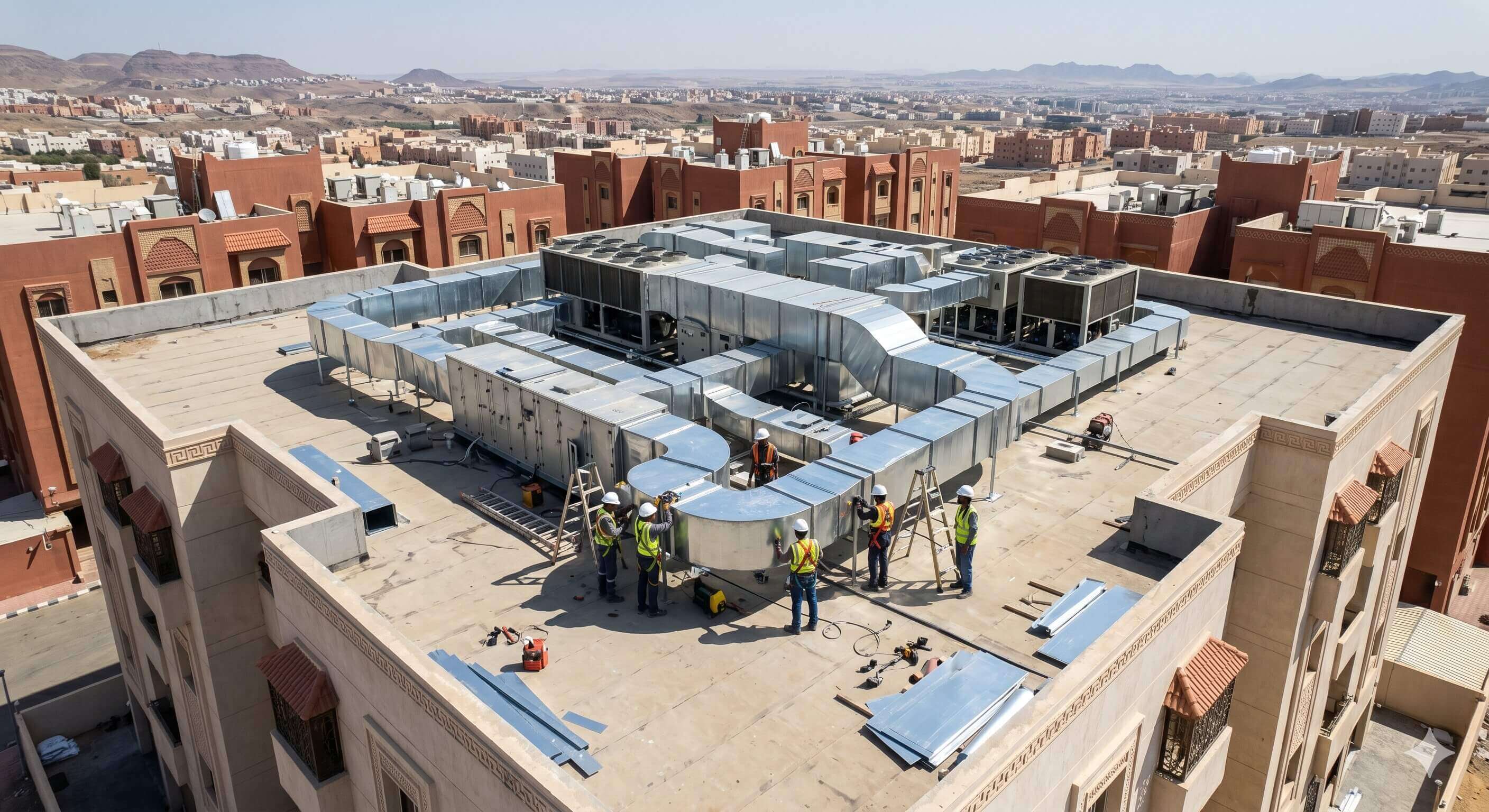
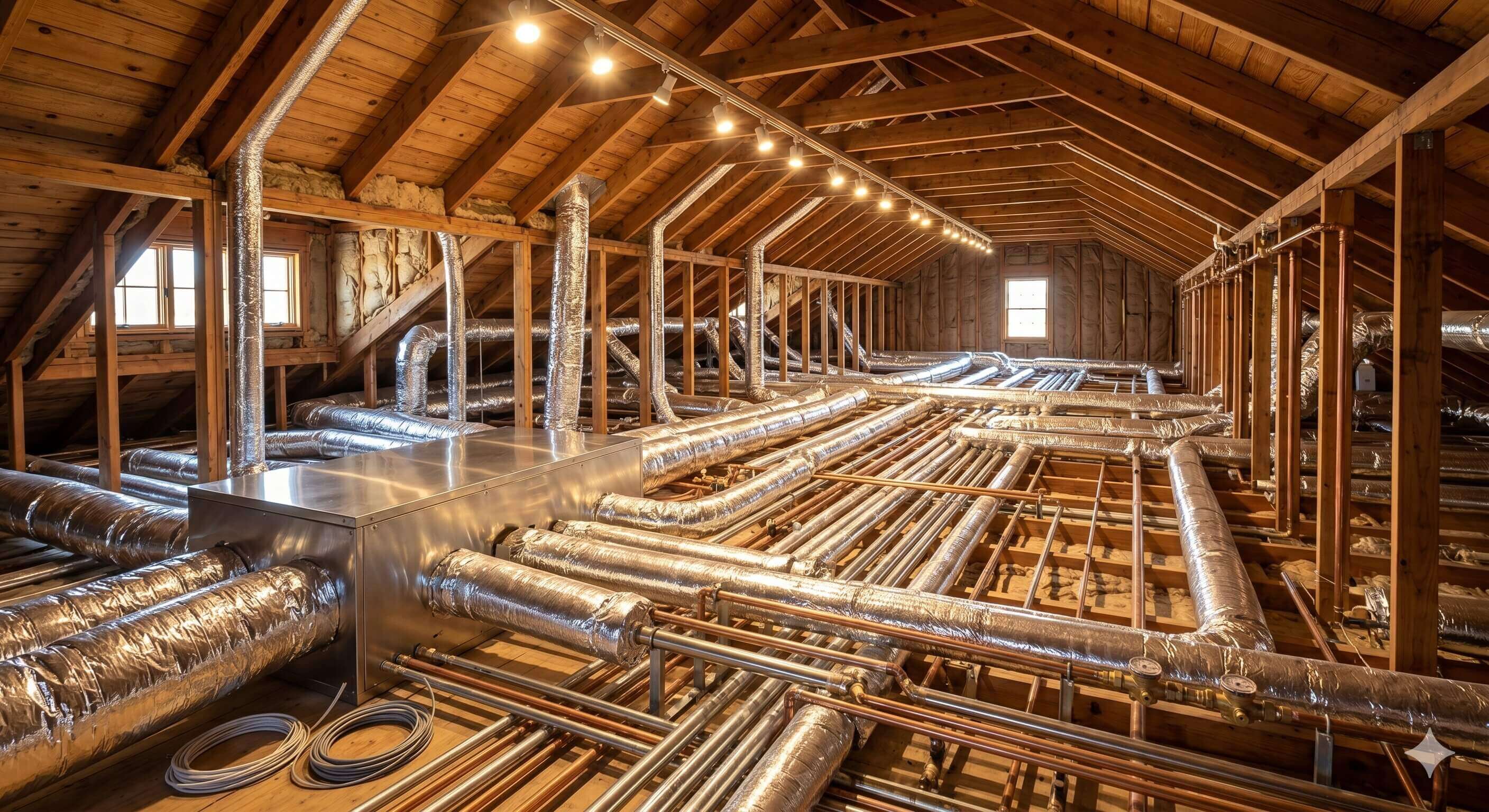
Central ducted AC installation is a significant project — higher cost than split, but when properly designed and executed it provides whole-home comfort from one quiet, ceiling-concealed unit.
Central AC Project Stages
1. Engineering Site Visit and Load Calculation
We conduct a free engineering visit before any purchase. We document every room, measure area and ceiling height, and calculate the heat load for each zone. In Abha we add the altitude factor (+10%) and the seasonal dual-use requirement (cooling and heating).
2. Ductwork Design
The heart of the project. Incorrect design means permanently unbalanced room temperatures. We calculate the correct air volume for each room based on its size and heat load. Dimensions, bends and damper positions are all engineered, not estimated.
3. Selecting the Unit at the Correct Capacity
The air handler is selected based on the total calculated load. In Khamis Mushait we add 20% for summer load. In Jazan, 25% for humidity load. An undersized unit runs continuously; an oversized one fails to remove adequate moisture.
4. Duct Installation with Mandatory Thermal Insulation
In Abha, the ceiling cavity reaches 40–45°C in summer while cooled air inside ducts is 12–14°C — a 30°C differential causing severe condensation and heat gain in uninsulated ducts. We use Fiberglass insulation at minimum 50mm thickness.
5. Air Balancing After Installation
We measure actual airflow at each register with an Anemometer and adjust dampers until air is distributed in the correct proportions. This step is frequently skipped by other contractors — it is the primary reason for room temperature imbalance complaints.
Expected Project Duration
Home Size
Expected Duration
3 rooms (small villa)
2–3 days
5–6 rooms (mid villa)
3–5 days
8+ rooms (large villa)
5–8 days
Frequently Asked Questions
Is central AC better than a separate split in each room?
Both have advantages. Central is quieter, aesthetically cleaner, one unit to maintain. Split is cheaper to install. For large villas, central is worth the investment.
Can central AC be installed in a home without a false ceiling?
Possible but more difficult. Ducts need a pathway — either a false ceiling or ceiling cavity. In some cases we use exposed ducts with decorative boxing.
What is the difference between central ducted AC and VRF/VRV?
Traditional central uses one air handler distributing air through ducts. VRF uses refrigerant pipes to individual indoor units per room with independent temperature control. VRF is more expensive but more flexible in large commercial buildings.
What determines whether a central installation succeeds?
The duct design, not the unit. An excellent unit on a poor duct network will perform poorly. Calculate the load per room, derive the airflow, then size the ducts — that's the correct order.
Can a central system be installed in an existing house?
It's possible, but it depends on available duct routes and sufficient ceiling heights. In some existing buildings, VRF or mini-split systems are a better and far less invasive answer than forcing in a full duct network.
How long does a central installation take?
Much longer than a split — days rather than hours, depending on the size of the building and the complexity of the network. We give you a realistic schedule after a site survey, not a guess over the phone.
Is a central system cheaper than several splits?
Not necessarily. Central cools the whole house as one — excellent if you use every room, wasteful if you use two. Multiple splits let you cool only what you're using. The decision depends on how you live in the house, not on absolute superiority.
How important is zoning?
Decisive in larger homes. Without it, the system cools upstairs and downstairs equally despite their loads being completely different. The result is one floor too cold and another too warm — the most common complaint on poorly designed central systems.
Can I add a room to the system later?
Sometimes, but it isn't automatic. Adding a branch changes airflow distribution across the whole network and can weaken existing rooms if it isn't rebalanced. We review the network before the addition, not after.
Does your AC need attention?
Call us now for a free assessment and instant quote