
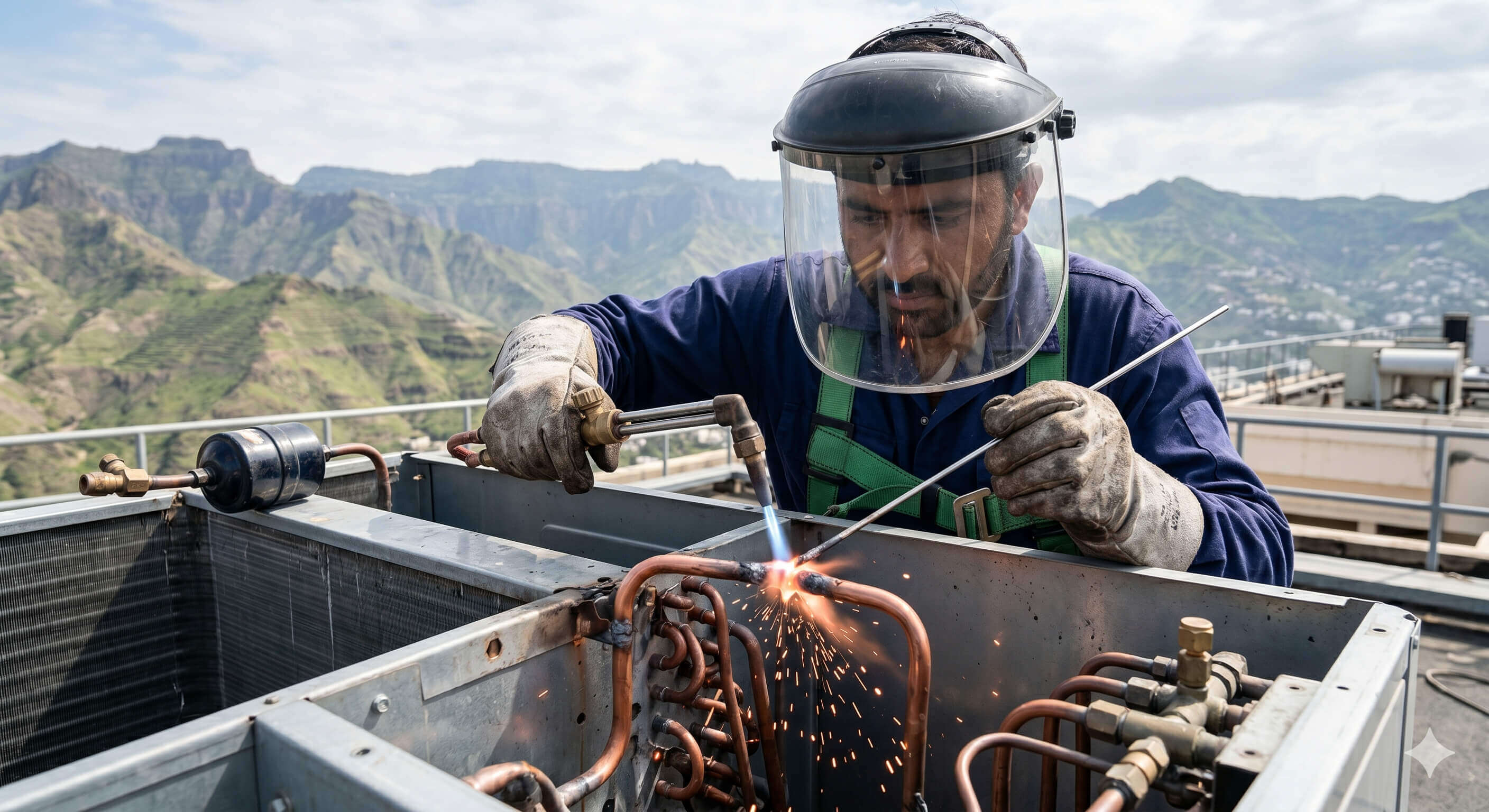
Refrigerant is not a consumable — a sound system retains its gas for years without loss. If your AC gas needs topping up every season, there is a leak that needs repairing, not just repeated recharging.
At 2,200m, refrigerant system pressures differ from low-elevation norms. Charging gas in Abha using standard low-elevation pressure values produces incorrect charge amounts. Our technicians are specifically trained to calibrate refrigerant charge for altitude, ensuring the correct amount every time.
Common Refrigerant Types in the Region
- R410A: The modern standard for most units manufactured after 2010
- R22: Older generation — still found in many older regional units. Now scarce and expensive
- R32: Newest generation — more efficient and lower environmental impact
A client had been recharging his AC gas every summer for 3 years. Before the fourth season, he called us. Electronic leak detection found a micro-leak at a pipe joint near the indoor unit. We sealed the joint and recharged to the correct amount, adjusted for Abha's altitude. Two full summers have since passed with no top-up needed.
Specialist Refrigerant Services — Beyond the Gas Recharge
A gas recharge is the last step in refrigerant circuit repair — not the first. Correct repair means diagnosing the leak, sealing it, verifying circuit integrity, and only then recharging.
Nitrogen Pressure Testing for Leaks
Before charging gas, we perform a nitrogen test: we pressurize the circuit with nitrogen to a specified level and monitor for 30–60 minutes. If pressure drops, there is a leak that must be located and repaired before refrigerant goes in. Charging gas into a leaking circuit wastes money and ignores the real problem.
Filter Drier Replacement
The filter drier removes moisture and contaminants from the refrigerant circuit. When the circuit is opened for repair or component replacement, moisture enters and damages the compressor and valves. We replace the drier every time we open the circuit — not only when replacing the compressor. In Jazan, high ambient humidity accelerates drier saturation and requires more frequent changes.
Thermostatic Expansion Valve (TXV) Replacement
The TXV controls the volume of liquid refrigerant fed to the evaporator coil. A failed TXV causes: coil freezing (if stuck open) or weak cooling (if stuck closed). Replacement requires opening the circuit, nitrogen testing, and full recharge. In Abha, seasonal load variations stress the TXV more than stable-climate regions, shortening its service life.
Capacitor Replacement (Run/Start)
Capacitors start and run electric motors. A failed Start Capacitor causes a hum followed by shutdown on startup attempt. A failed Run Capacitor causes slow rotation and high current draw. Both can be confused with compressor failure and misdiagnosed. In Khamis Mushait's long summer, both types fail at an elevated rate — capacitor inspection is part of every pre-summer service.
High/Low Pressure Switch Inspection
Pressure switches protect the circuit from overload. The high-pressure switch cuts the circuit if gas pressure exceeds safe limits — common in Khamis Mushait summer if the outdoor unit is surrounded by walls that block ventilation. The low-pressure switch protects against severe refrigerant shortage. Failed switches either shut the unit down without cause or fail to protect when genuinely needed.
Evaporator Coil Cleaning
The evaporator coil is where refrigerant vaporises and absorbs heat from indoor air. A thin film of grease and dust on the coil significantly reduces heat transfer. In Jazan, coastal moisture holds dust in a sticky layer that requires specialist chemical cleaners, not just water pressure.
Condenser Coil Cleaning
The condenser coil in the outdoor unit releases heat to outside air. A fouled coil raises condensing pressure and stresses the compressor. In Abha, spring dust forms a dense plug on the fins. Cleaning with medium water pressure (not high pressure that bends fins) restores 90% of coil performance.
Copper Line and Joint Inspection
Copper refrigerant lines face continuous vibration and thermal expansion and contraction. Joints are the weak points. In Jazan, coastal salt air accelerates copper oxidation and weakens brazed joints over time. We inspect lines visually and with an electronic leak detector at every comprehensive service.
Compressor Oil Level and Contamination Check
The compressor requires oil mixed with refrigerant for lubrication. When refrigerant leaks, oil leaks with it. Recharging gas into an oil-depleted compressor causes rapid wear. We add manufacturer-approved oil where needed — not commercially available alternatives that may be incompatible.