
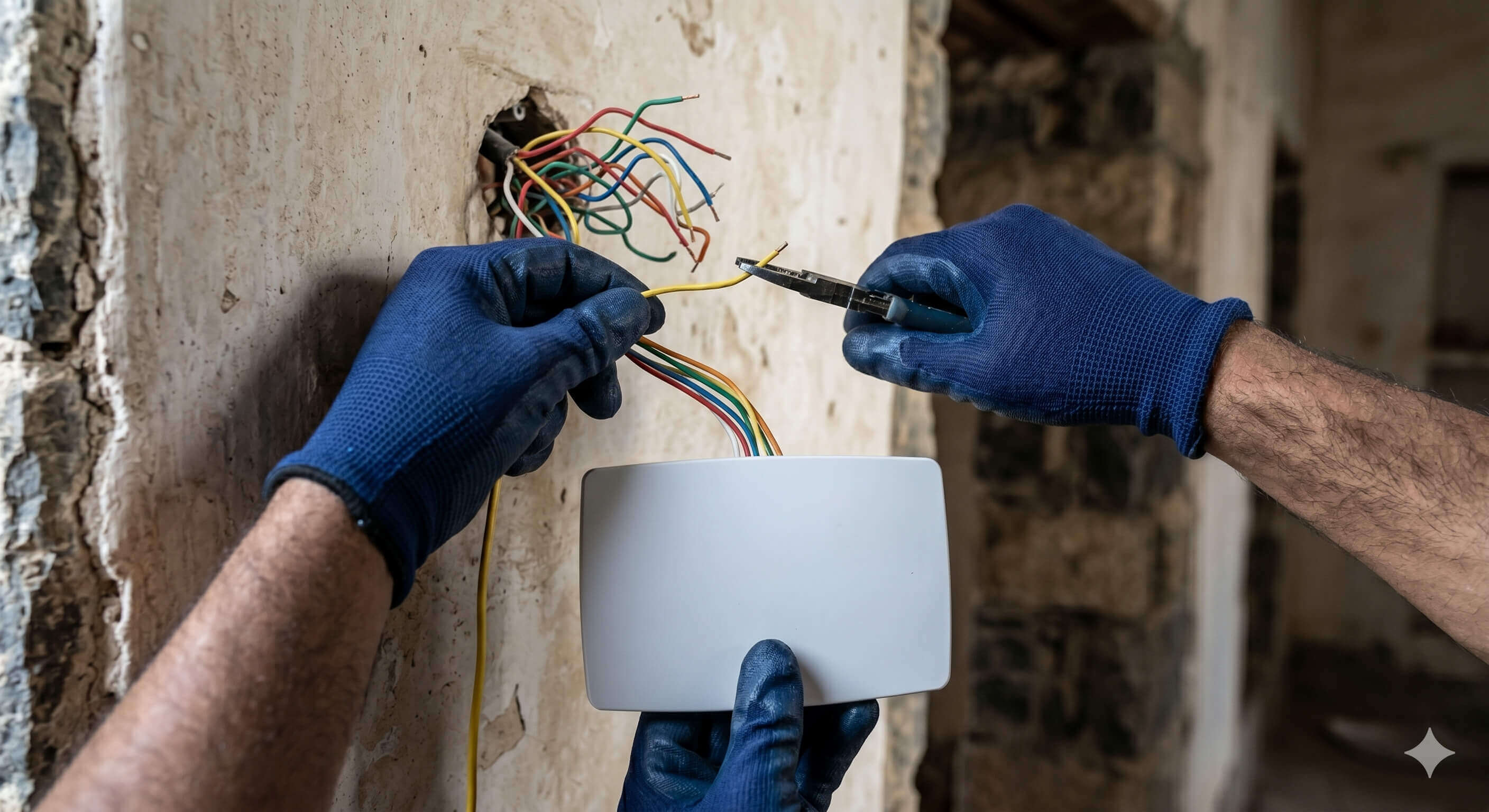
The thermostat controls the AC's operating cycle — stopping it when the room reaches the target temperature and restarting it when temperature rises. A faulty thermostat causes two opposite problems: an AC that never stops, or an AC that never starts.
Common Thermostat Faults in the Region
Abha — Large Day-Night Temperature Swings
Abha sees temperature differentials up to 15°C between midday and midnight. The thermostat must handle this wide range accurately. A common pattern: AC that doesn't stop in Abha despite the room being adequately cool — the thermostat is reading incorrectly because it is positioned near a heat source or away from the airstream.
Jazan — Humidity and Sensor Perception
Thermostats measure dry temperature. In Jazan at 80%+ humidity, the perceived heat is much higher than the measured reading. This means the thermostat may stop the AC at a temperature that is "correct" numerically but still uncomfortable for occupants.
Khamis Mushait — Short Cycling Caused by Thermostat
A poorly calibrated thermostat or one positioned directly in the cold airstream from the AC causes short cycling — stopping the unit too early then restarting it minutes later. In Khamis Mushait, this stresses the compressor through excessive startup cycles in an already demanding summer.
Thermostat Fault Diagnosis
| Symptom | Likely Problem | Fix |
|---|---|---|
| AC never stops | Thermostat not reading temperature accurately | Calibrate or replace |
| AC won't start despite heat | Thermostat sending no start signal | Check wiring + replace |
| Room temp doesn't match setting | Wrong calibration or thermostat position | Recalibrate or relocate |
| Repeated short cycling | Thermostat in direct cold airstream | Reposition the thermostat |
Smart Thermostat — Is the Upgrade Worth It?
A smart WiFi thermostat enables remote control from your phone, automatic scheduling, and consumption statistics. In Abha, programming it to raise the temperature during absence hours and lower it an hour before arrival saves meaningful electricity. Cost: around SAR 300–800 — typically paying for itself in 1–2 years through electricity savings.
Thermostat Fault and Compressor Health
A faulty thermostat causes continuous compressor operation (AC never stops) or repeated short cycling — both measurably shorten compressor life. Fixing the thermostat promptly protects the far more expensive compressor.
What is an AC thermostat, and what does it actually do?
A thermostat is not an on/off switch. It is a temperature sensor wired to a switch: it measures the air temperature, compares it against the setting you chose, and decides when to run the AC and when to stop it. Every decision your AC makes — when to cool, for how long, when to cut out — begins with that reading.
Which is why a thermostat that reads wrongly doesn't "break" in any obvious sense. It makes a perfectly healthy AC behave badly. The AC is obeying an instruction built on bad information.
The types — and which one you have
- Mechanical thermostat: uses a bimetallic strip that bends with heat to open or close a circuit. Simple and durable, but imprecise — it can be two degrees or more out.
- Digital thermostat: uses an electronic sensor (a thermistor) and is far more accurate. This is what's inside most modern split units, usually integrated into the indoor unit and controlled by the remote.
- Programmable / smart thermostat: adds scheduling and remote control. It does not cool more efficiently by itself — it prevents cooling when you don't need it.
An important point: in most Saudi split systems there is no separate wall thermostat as there is in American central systems. The sensor sits inside the indoor unit and the remote is only a control interface. That changes the nature of the fault entirely — and many technicians confuse the two.
How to tell whether it's the thermostat or the AC
A practical three-step test:
- Set it to the lowest possible temperature. If the AC doesn't respond at all — no relay click, no start — the fault is likely the thermostat or its power supply.
- If the AC starts but the room doesn't cool, the problem is the AC (refrigerant, coil, compressor), not the thermostat.
- If the room is cold and the thermostat insists it's warm (or the reverse), the sensor is reading wrongly — and that's the classic thermostat fault.
Position matters more than the device
This is the most-neglected point of all. A thermostat reads the temperature where it is, not in the middle of the room. So if it sits:
- on a wall in direct sun → it reads too warm → it keeps the AC running needlessly → higher bill.
- above a heat source (a TV, a light, a kitchen) → same result.
- in a cold draught → it reads too cool → it cuts the AC off early → a room that never actually cools.
In those cases the fix is to move the thermostat, not replace it. Replacing a healthy device changes nothing if it goes back in the same wrong place.
Why this matters particularly in our climate
In Khamis Mushait, dust settles on the sensor and insulates it, so it responds more slowly than the real air temperature. In Jazan, high humidity means perceived temperature differs sharply from measured temperature; a room at 24°C in high humidity feels far warmer than the same room in Abha — so people drop the thermostat several degrees further and pay for it on the bill, when the real problem is humidity, not heat.