
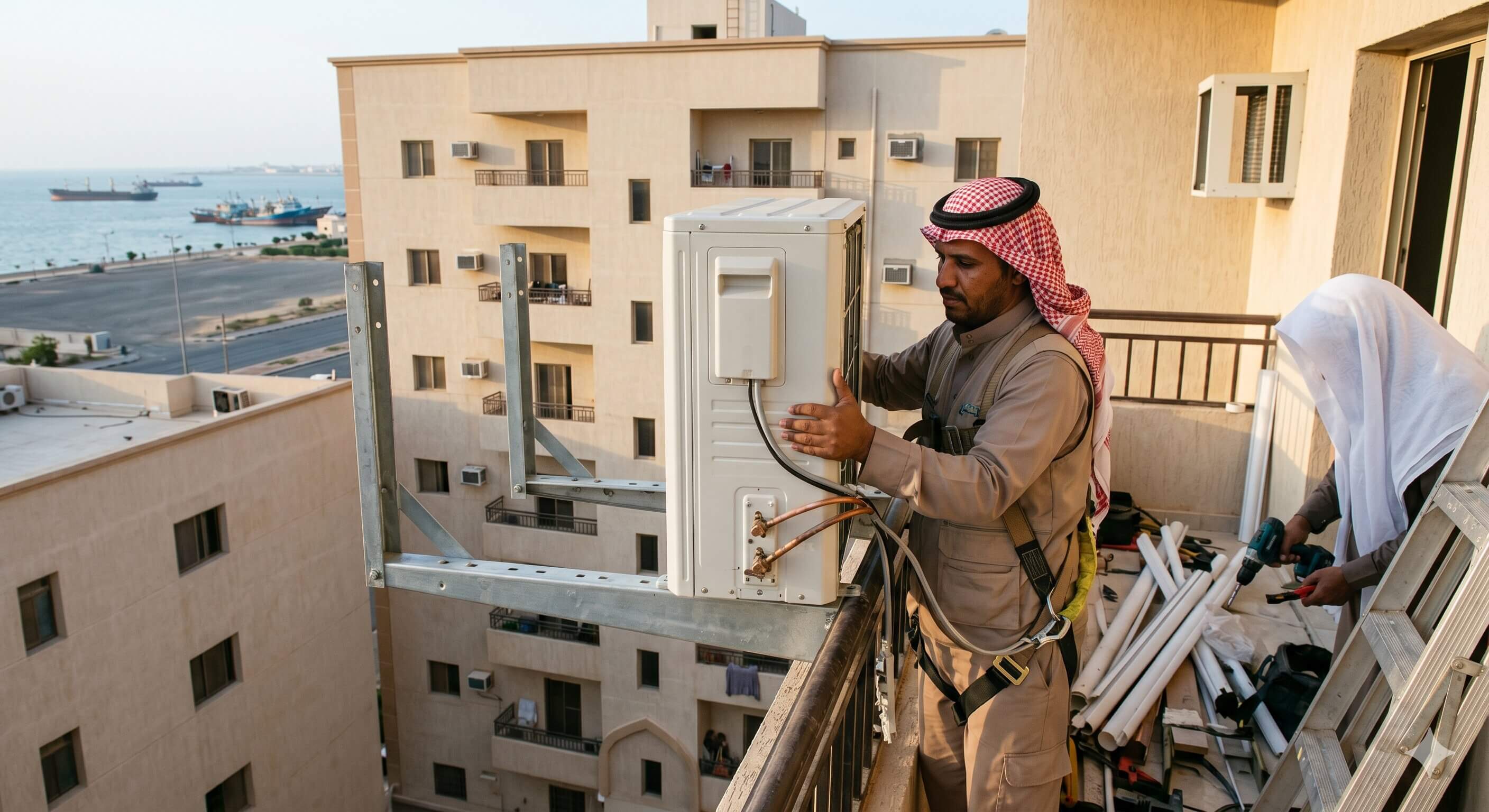
Moving an AC from one apartment to another, or from room to room, is one of the most requested services in Saudi Arabia — people move often. It is also the service in which more healthy air conditioners are destroyed than any other, because most people performing it treat it as a dismantle-and-refit. It isn't.
Relocation is not a "new installation" — and it is not just a "removal"
A new installation starts with a sealed, factory-charged unit and new pipework. A relocation starts with a circuit that has already been opened, pipework that has been in service for years, and flare joints that have already been tightened once. Each of those three is a potential point of failure.
The three mistakes that kill an AC during a move
- Venting the refrigerant instead of recovering it. The fast method is to crack the valves and let the gas escape. It's environmentally harmful, and it also means you'll pay for a full new charge. The correct method is to pump the refrigerant down into the outdoor unit and seal it there before disassembly.
- Reusing the old flare joints. A copper flare work-hardens once it has been tightened. Undoing it and re-tightening onto that same hardened surface means a leak — not today, but in a few weeks. The joints must be cut back and re-flared, not simply done back up.
- Skipping evacuation at the new location. Opening the system lets in air and moisture. Anyone who restarts it without pulling a vacuum has sealed moisture inside the circuit — and moisture plus oil forms acids that destroy the compressor over a few years, long after whoever moved it has been forgotten.
Can the old copper pipework be reused?
Sometimes — not always, and the difference matters. We check three things: whether the pipe length suits the new position (longer or shorter changes the required charge); whether the pipe is free of corrosion (in Jazan especially, the copper may have degraded from the outside); and whether the old compressor ever burned out — because the acids from a compressor burnout stay in the pipework and will destroy any new compressor. In that case the pipes get replaced, not flushed.
A move is your one chance to correct an old installation mistake
This is the point everybody misses. You are already paying to take the unit down and put it back up — so why put it back in a bad position?
- In Abha: moving the outdoor unit off an exposed rooftop and onto a shaded wall measurably improves summer performance. A unit in direct sun runs at higher discharge pressure for its entire life.
- In Khamis Mushait: moving the outdoor unit away from unpaved ground or a neighbouring construction site cuts the dust load on the coil — the leading cause of summer failures here.
- In Jazan: moving the unit off the direct sea-facing elevation, where that's possible, reduces the salt load and adds years to the coil's life.
And the indoor unit's position too. Many "it doesn't cool the room" complaints come down to an indoor unit blowing straight at a wall or a wardrobe. A move is the right moment to fix that, at essentially no extra cost.
What we actually do
- Pump the refrigerant down into the outdoor unit and seal it — never vent it.
- Remove both units and clean them before refitting — a dismantled unit is easier to clean than it will ever be again.
- Cut back and re-form the flare joints with a flaring tool, rather than reusing the old ones.
- Inspect the pipework, and recalculate the charge if the length has changed.
- Pull a vacuum on the circuit at the new location before releasing the refrigerant.
- Leak-test, and measure superheat and subcooling to confirm the charge is correct.
Or sell the old unit instead of moving it