
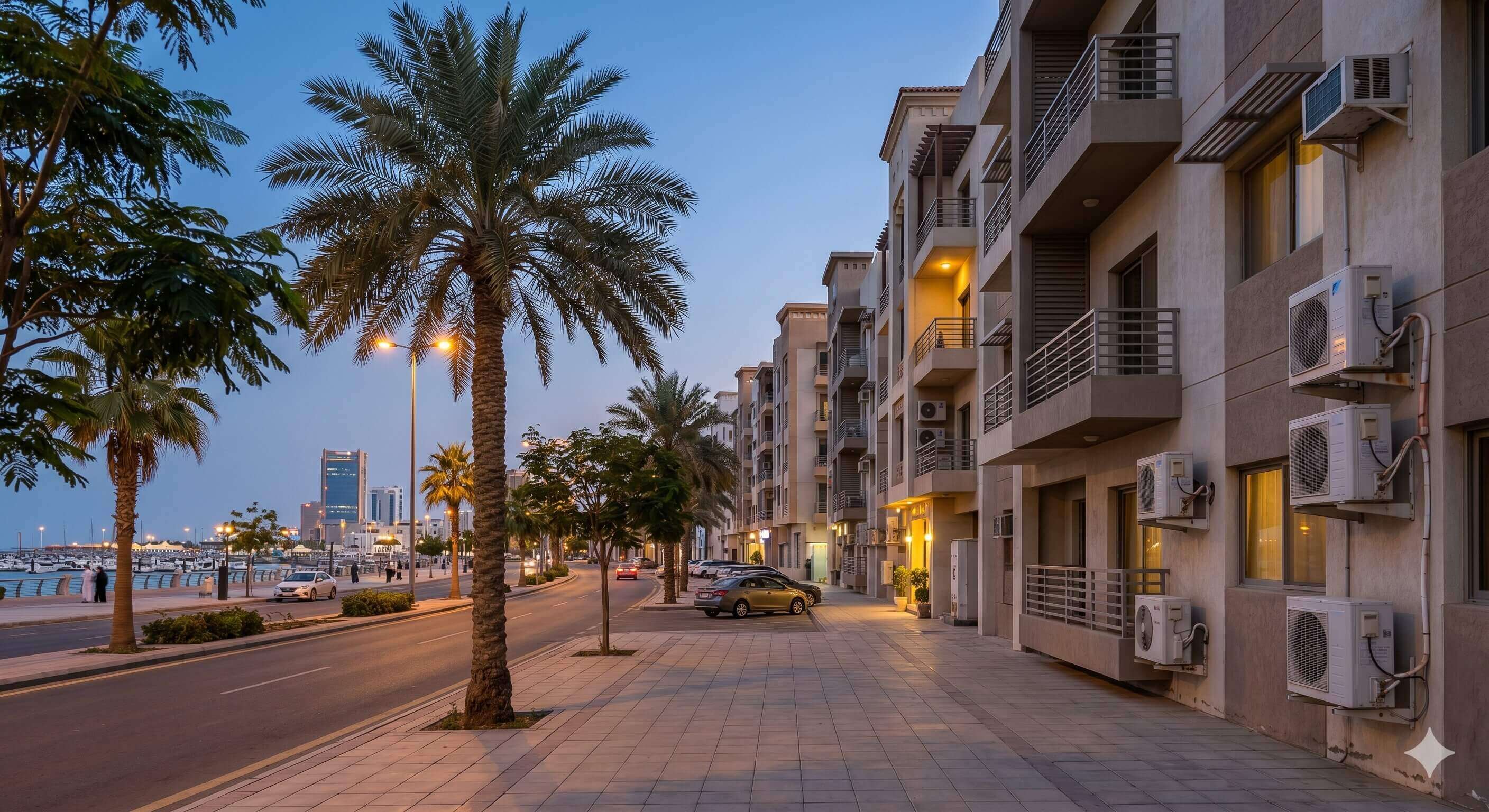
Khobar faces the Gulf directly, and its buildings are dense and tall. That creates a specific combination: the Gulf's extreme humidity, salt reaching units mounted high above the ground, and volumes of condensate that drainage systems were never designed to carry.
The first problem: the AC cools, but the room still feels clammy
This is the most common complaint we hear in Khobar — and it's usually not a fault at all, but a misunderstanding of what the AC is doing.
The Gulf is a shallow, warm sea, so the air above it is loaded with water to a degree inland cities never experience. Your AC therefore spends a large share of its energy drying the air rather than cooling it. And when it fails to dry the air, you get a room that is cold by the thermometer and damp by feel.
And why does it fail to dry? Usually because it's too big
- Removing moisture from air takes run time, not more cooling capacity.
- An oversized unit drops the temperature fast and shuts off — before it has removed any meaningful amount of water.
- So you feel uncomfortable, turn the thermostat down further, worsen the short cycling, raise the bill and tire the compressor.
A correctly sized unit runs for longer at lower capacity — which is exactly what dries the air. It's also why inverter units perform well in Khobar when they're sized correctly: continuous running at partial capacity means continuous dehumidification.
The second problem: the sheer volume of water
A high latent load means your AC produces a very large volume of condensate every day. Many buildings' drainage was never designed for that volume, or has been neglected until it narrowed.
The result: an overflowing pan, water tracking into a wall or ceiling, and in a high-rise apartment, damage that extends to the neighbours below you. A float switch — which shuts the unit down before it overflows — is not an optional extra in Khobar. And in ceiling cassettes and concealed units, the condensate pump is the first point of failure.
The third problem: salt at height
Outdoor units on Khobar's towers and taller buildings are exposed to salt-laden sea air with nothing in the way. Galvanic corrosion eats the aluminium fins until they crumble, cooling degrades progressively, and eventually the coil perforates and begins to leak.
Access makes it worse: a unit that's hard to reach is a unit that doesn't get cleaned — so it degrades silently until it stops.
What we check in Khobar specifically
- Unit size against the room's actual load — a cold, clammy room usually means an oversized unit, which is the opposite of what most people assume.
- Dehumidification performance — run time and temperature split, not temperature alone.
- The drain line, pan and condensate pump, and the float switch — the single most important item in a high-rise.
- Coil corrosion, with acid washing and protective coating for exposed units.
- The control box — salty humidity oxidises capacitors, contactors and their terminals.
Our services in Khobar
Our Eastern Province team covers the full range: residential units, commercial systems including VRF, chillers and air handling units, plus buying and selling used and new air conditioners.
The faults we're actually called to in Khobar — in order
- Drain overflow and water leaks. These top the list in Khobar more than in any other city. The moisture load produces a very large volume of condensate, and in a high-rise an overflow means your neighbour's ceiling, not your floor.
- Capacitors and contactors — salty humidity oxidises the terminals so they lose capacitance. "The unit hums but won't turn" is the symptom.
- Coil corrosion on elevated units. Units on Gulf-facing elevations take salt with nothing in the way — the fins crumble and cooling degrades progressively.
- The condensate pump in cassettes and concealed units — the first point of failure in ceiling systems, and the most expensive when neglected.
- "It cools but the air stays clammy" — usually not a fault at all, but an oversized unit that never runs long enough to dry the air.
The systems we service in Khobar
- Split and window — the residential norm.
- Cassette and concealed — common in tower apartments, where the condensate pump is critical.
- Central and ducted — we inspect the ductwork and its static pressure, not just the unit.
- VRF, chillers and air handling units — serviced locally. In a facility whose downtime is costed by the hour, the difference between a local technician and a team travelling from Riyadh is the whole contract.
Towers and high-rise flats — considerations that don't exist in a villa
- A float switch isn't optional. It shuts the unit down before the pan overflows — and prevents damage that extends to your neighbours.
- The drain route must have correct fall and be as short as practical. Insufficient fall shows up after months, not days.
- Access to the outdoor unit is fundamental: a unit that can't be reached won't be cleaned, and a unit that isn't cleaned in this climate dies early.
- Gypsum ceilings — a small, persistent leak destroys the ceiling silently before you notice it.
The right maintenance schedule for Khobar
- Before summer: a deep wash of both coils, a charge check by calculation rather than guesswork, and a compressor current-draw measurement.
- Regularly: clear the drain line and check the condensate pump and float switch — the most important item in a high-rise.
- For sea-facing units: acid washing and a protective coating at a higher frequency. The salt doesn't stop.
And we buy and sell air conditioners in Khobar too
Used and new. We inspect and value on actual condition — compressor history, coil corrosion, whether the circuit is sealed — not on appearance. And if the fault is a cheap capacitor repair, we'll tell you that you're better off not selling.
What we commit to
- We diagnose before we price — no final figure by phone for a fault we haven't seen.
- A 90-day warranty on repair work.
- Genuine OEM parts, and we're not an agent for any brand.
- We won't promise an arrival time we can't meet.
Related services
Concealed & ducted AC in Khobar