
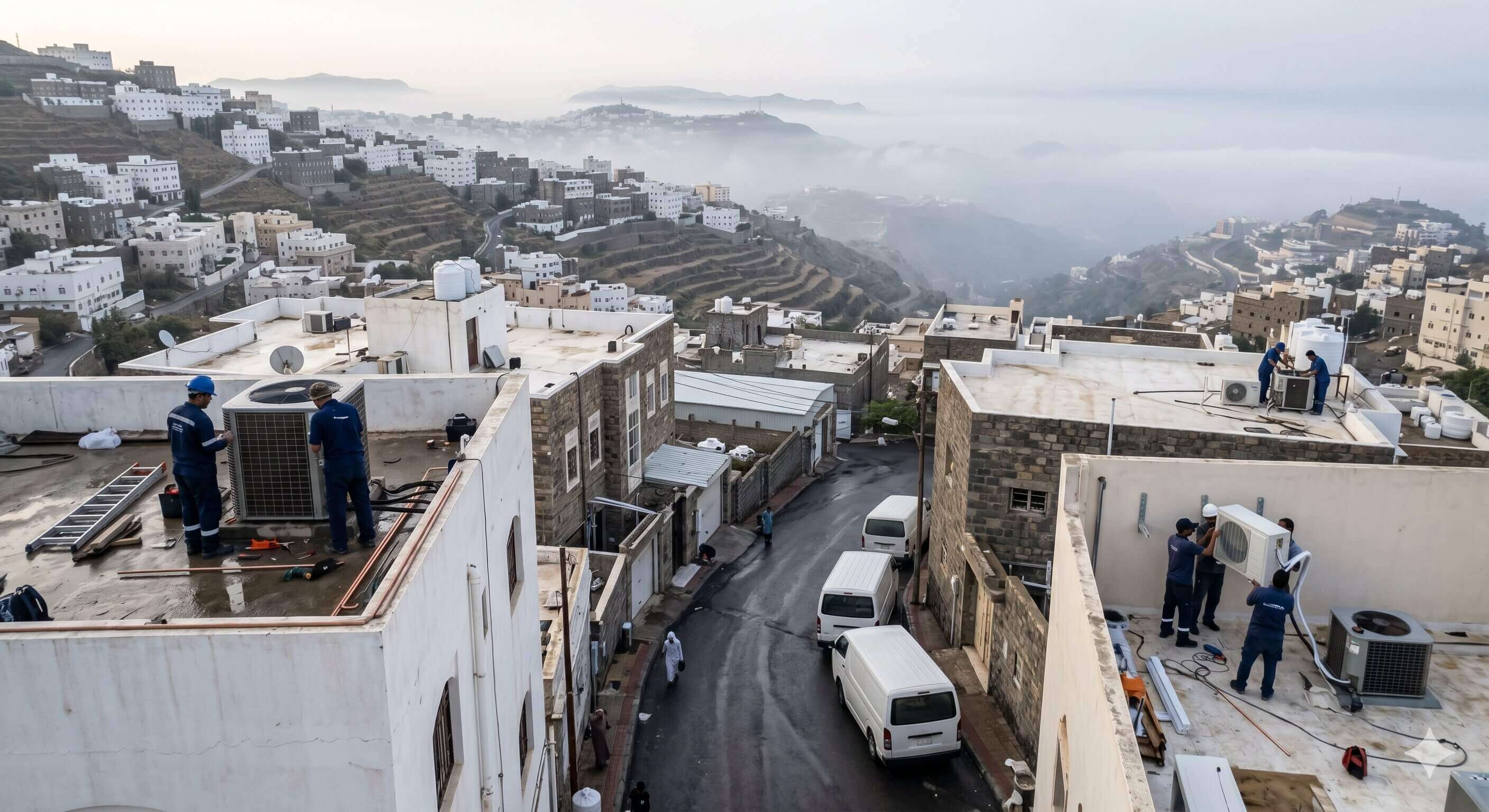
Ahad Rufaidah is minutes from Khamis Mushait, and yet what your air conditioner faces here is not a copy of what it faces there. The difference isn't distance — it's the kind of material getting into the coil.
Agricultural dust, not construction dust
This is the essential point, and it is invariably missed. In Khamis Mushait, the airborne load is fundamentally mineral: soil, sand, and dust from construction sites. That dust is inert — it blocks a coil mechanically and does nothing more.
In the farmland around Ahad Rufaidah, the load is different: pollen, plant fibres, crop residue, and tilled agricultural soil. That is organic matter — and the distinction has two practical consequences:
- Organic matter mats. Mineral dust settles between the fins and can be washed out. Plant fibres and pollen tangle with moisture and form a matted layer that adheres to the coil and resists a surface rinse.
- Organic matter is food. Nothing grows on mineral dust. Organic matter settled on a damp coil is a growth medium for fungi — which turns a blockage problem into an air-quality problem.
Which is why a filter in Ahad Rufaidah clogs faster than the look of the air would suggest — and why odour complaints here follow the Abha pattern rather than the Khamis Mushait one.
And the highland nights complete the picture
Ahad Rufaidah sits in the Asir highlands, and the nights are cold. An AC that sits idle through long nights leaves standing water in the drain pan. Add the organic matter that reached the coil during the day, and you have the complete recipe for a musty smell: stagnant moisture, organic material, and a cold surface.
This is why "cleaning the filter" alone doesn't solve an odour problem here. The filter isn't the source — the pan and the coil are.
What we check in Ahad Rufaidah specifically
- The filter, more often than standard intervals suggest — an organic load blocks it faster than mineral dust of the same apparent density.
- A deep coil wash, not a rinse. A matted organic layer will not lift with water applied to the surface.
- The drain pan and condensate line — the single most important item here, and the source of most odour complaints.
- Inspection for fungal growth on the coil and pan, with disinfection where found. Washing alone does not kill spores.
- The outdoor unit's position — proximity to a farm or a ploughed field multiplies the load, and sometimes relocating the unit beats increasing the cleaning frequency.
How we serve you — honestly
We do not have a branch in Ahad Rufaidah, and we won't pretend otherwise. We serve it from our Khamis Mushait base, which is close enough to fall within our normal service range. We tell you the realistic arrival time when you call — we don't promise sixty minutes and turn up in two hours.
And the same principle applies to everything else: we diagnose before we price, we don't give a final figure for a fault we haven't seen, and we tell you plainly when replacement beats repair.