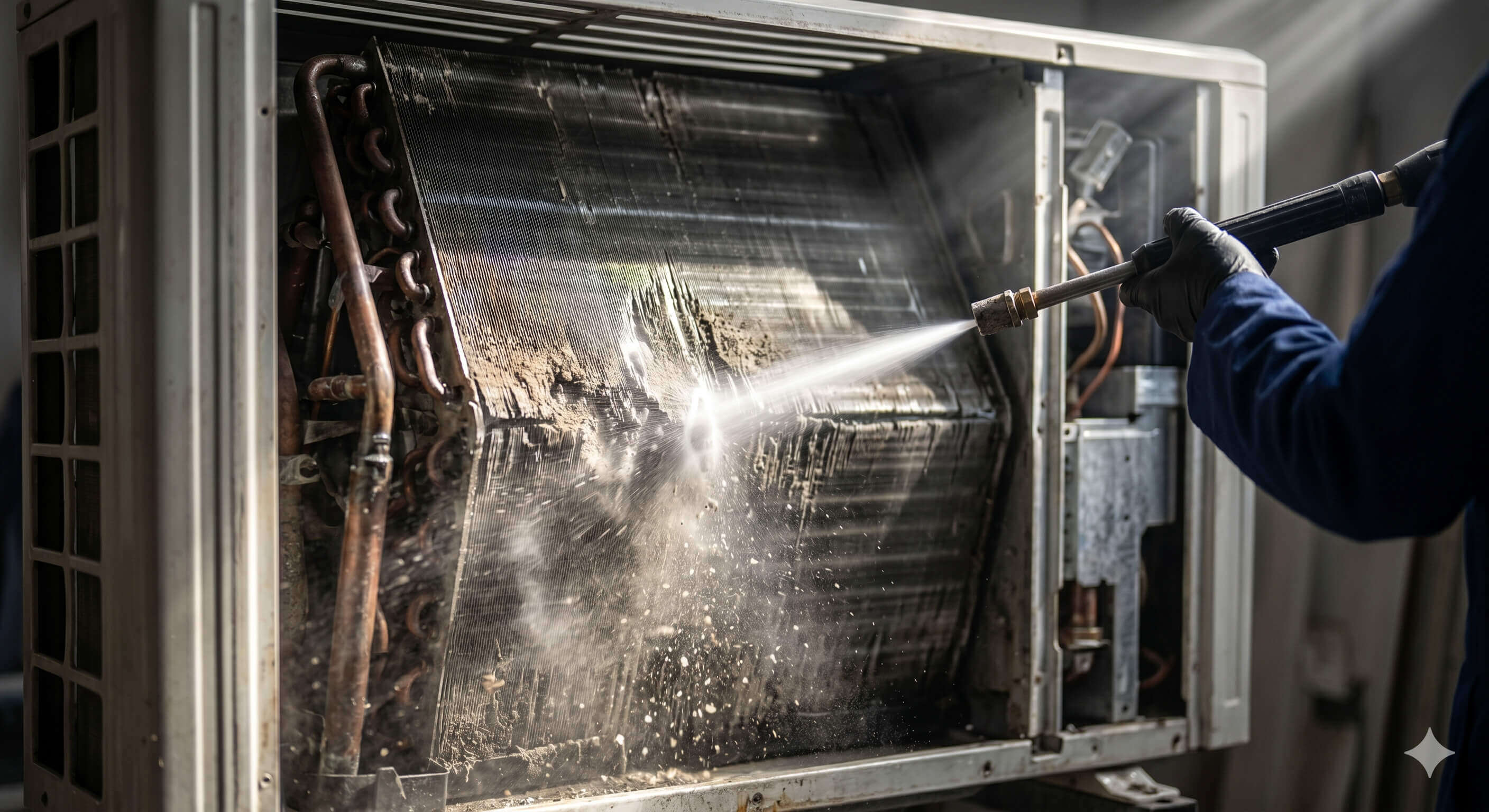
Why an AC in Jazan needs a different clean from one 30km away — and what we actually do about it.
✓ Indoor & outdoor units✓ Safe products✓ Steam cleaning✓ No full disassembly
Jazan is the hardest city in the region on air conditioners — and heat is not the reason. The problem here is chemical: coastal air carries salt aerosol, and salt attacks metal.
Salt eats your AC — literally
The outdoor unit is built from aluminium fins bonded to copper tubing. When salt dissolved in humidity settles across the junction of two dissimilar metals, galvanic corrosion begins: the aluminium corrodes preferentially to protect the copper. The result is fins that crumble and fall away, cooling capacity that collapses over time — and eventually a coil leak that cannot be repaired.
This does not happen in Abha or Khamis Mushait. It is why washing a Jazan AC with water alone is not cleaning — it is postponement. Water lifts the salt off the surface and leaves behind everything that has worked its way between the fins.
And the humidity creates a second problem
Jazan's high humidity means heavy condensation — a constant volume of water in the drain pan. Warm standing water in the dark grows algae and biofilm, which blocks the drain line. When the line blocks, water overflows from the indoor unit into the wall.
Most of the "my AC is leaking water" calls we take from Jazan are not leaks at all. They are drain lines blocked with algae.
What we actually do in Jazan
Acid coil wash — to dissolve the salts and oxides packed between the fins, rather than rinsing the surface.
Anti-corrosion coating on the outdoor unit — a preventative that adds years to coil life in a coastal environment.
Algae treatment programme for the drain pan and condensate line.
P-trap and float switch — so an overflowing pan never reaches the wall.
Distance from the sea changes everything
A unit on the Corniche or near the port takes a far heavier salt load than one inland, and needs treatment more often. This is the single biggest driver of annual maintenance cost in Jazan — more than the type or size of the unit.
Jazan districts we cover
We cover Al Nour, Al Rawabi, Al Shatee, Al Rawdah, Al Zuhour, Al Salhiyah, Al Nuzha, The Corniche and the surrounding areas.
Frequently Asked Questions
Why does the outdoor unit corrode so fast in Jazan?
Galvanic corrosion. The aluminium fins are bonded to copper tubing, and when damp salt settles across the junction of the two metals, the aluminium corrodes preferentially to protect the copper. The fins crumble and fall away, and cooling capacity collapses over time.
Is a water wash enough for an AC in Jazan?
No. Water lifts salt off the surface and leaves what has worked its way between the fins. A coastal environment needs an acid wash to dissolve the accumulated salts and oxides, ideally followed by an anti-corrosion coating.
My AC is leaking water — is that a gas leak?
Usually not. Most water-leak calls we take from Jazan are drain lines blocked with algae. High humidity keeps a constant volume of water in the pan, and warm standing water grows biofilm that blocks the line until it overflows.
Is anti-corrosion coating worth the cost?
In Jazan, yes — especially for units near the sea. It is a preventative that adds years to coil life, whereas replacing a corroded coil costs several times as much.
Why does maintenance cost more on the Corniche than inland?
Proximity to the sea is the dominant factor. A unit on the Corniche or near the port takes a much heavier salt load and needs treatment more often — more than the type or size of the unit affects it.
Why isn't a water wash enough in Jazan?
Because water lifts salt off the surface and leaves what has worked its way between the fins. The remaining salt keeps driving galvanic corrosion. A coastal environment needs an acid wash to dissolve the salts and oxides that accumulate deeper in.
When should an anti-corrosion coating be applied?
After an acid wash, and before corrosion has a chance to take hold. The coating is a preventative that adds years to coil life — and replacing a corroded coil costs several times as much.
Is algae treatment needed every season?
In Jazan, yes. Constant humidity keeps water in the pan at all times, and warm standing water grows biofilm that blocks the line. Routine treatment costs less than repairing a wall that water has leaked into.
Does proximity to the sea change the cleaning schedule?
Decisively. A unit on the Corniche or near the port takes a far heavier salt load and needs treatment more often than one inland. It's the single biggest factor in your annual maintenance cost here.
Does your AC need attention?
Call us now for a free assessment and instant quote