
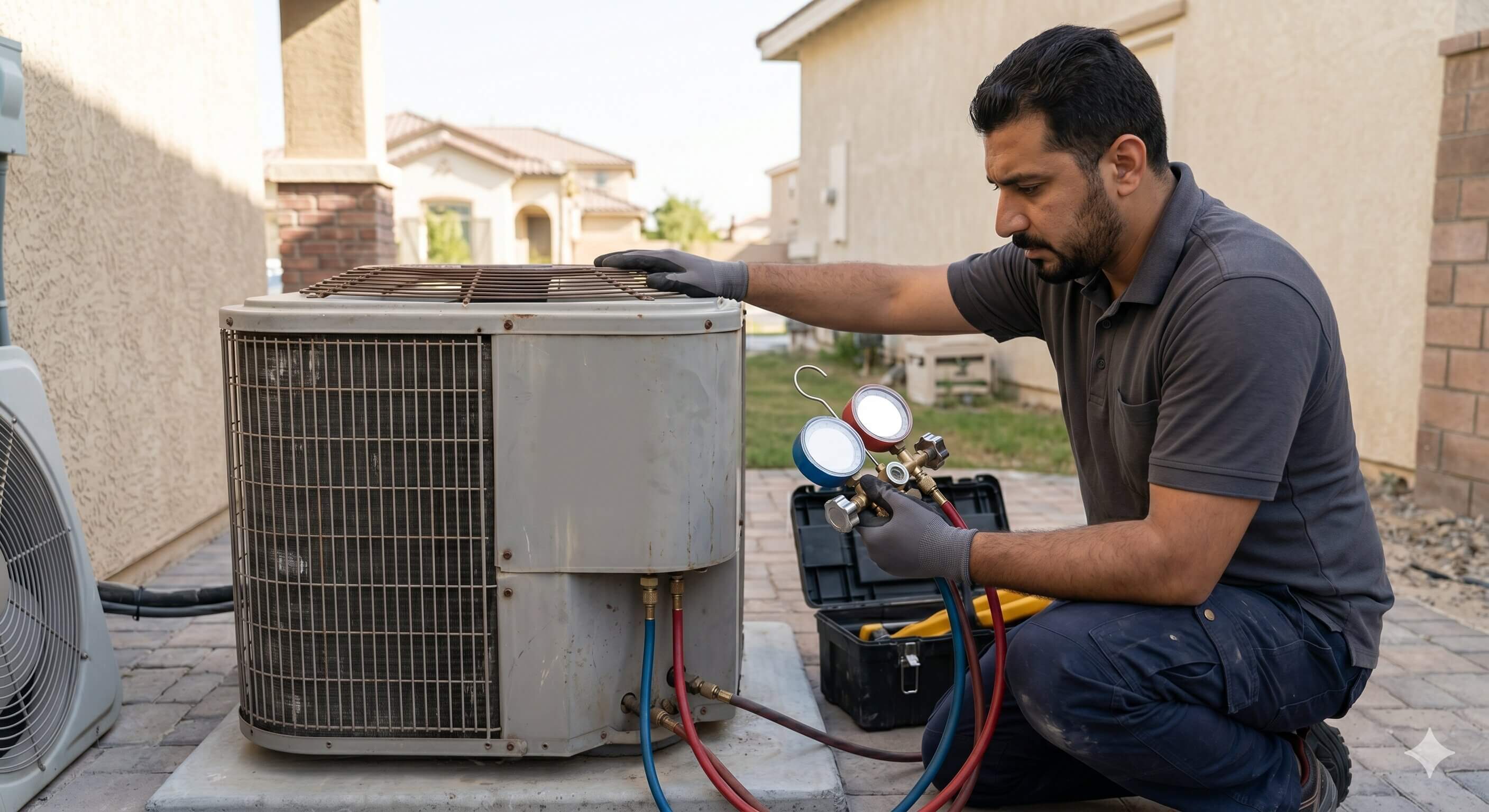
"Your AC needs a gas top-up" is one of the most frequently said — and most misunderstood — sentences in Saudi Arabia. Before you pay for a charge, it helps to know what's actually inside your unit, and why the types cannot be treated as interchangeable.
The first rule: refrigerant is not consumed
An air conditioner is a sealed circuit. The refrigerant cycles around it indefinitely: it evaporates, is compressed, condenses, expands, and returns. It isn't burned, it isn't used up, and it doesn't "run out" over time.
So if the charge is low, there is a leak. There is no exception to that rule. Anyone who refills without finding the leak is selling you the same problem every season — and leaving your compressor running undercooled in the meantime.
The three types you'll encounter
- R‑22: the old generation. You'll find it only in older units, and it's being phased out globally for environmental reasons. If your unit runs on it, that's a significant factor in any repair-versus-replace decision — because its availability and cost are both moving the wrong way.
- R‑410A: the most common refrigerant in modern split units in the Saudi market. It operates at far higher pressures than R‑22 — which is precisely why one cannot be substituted for the other in the same system without modification.
- R‑32: the newest generation, used in many new units. Better heat-transfer efficiency, and a lower global warming impact than R‑410A.
Where do you find the type? It's printed on the data plate of the outdoor unit. Don't guess — a technician who "knows by looking" doesn't know.
Why the types must never be mixed
Three physical reasons, not preferences:
- The pressures differ. Charging R‑410A into a system designed for R‑22 subjects the components to pressures beyond what they were built to take.
- The oils differ. Each refrigerant works with a specific oil that circulates with it and lubricates the compressor. The wrong oil means a compressor without effective lubrication.
- Mixing two refrigerants in one circuit produces a blend that behaves like neither, and whose charge cannot be set against any manufacturer's table — meaning the system can no longer be calibrated at all.
The "correct charge" is a calculated figure, not a feeling
This is the single biggest thing separating good work from bad. A correct charge isn't judged by pressure alone, but by calculating superheat and subcooling and comparing them against the manufacturer's table.
Why should you care? Because an overcharge is not "better" than an undercharge — it can be worse. Overcharging raises discharge pressure, strains the compressor, and can return liquid refrigerant to it. Liquid does not compress, and that breaks a compressor mechanically.
What does this have to do with our climate?
In Jazan, salt corrosion perforates the condenser coil from the outside in — so the coil itself becomes the leak, not the joints. That's why "low refrigerant" recurs there more than in any other city, and why the real fix is preventive: an anti-corrosion coating, not an annual recharge.
In Khamis Mushait, a dust-clogged coil raises discharge pressure — so the system can read as if it were "overcharged" when the real problem is that heat isn't being rejected. A technician reading pressures without cleaning the coil may remove perfectly good refrigerant from a system that didn't need it.