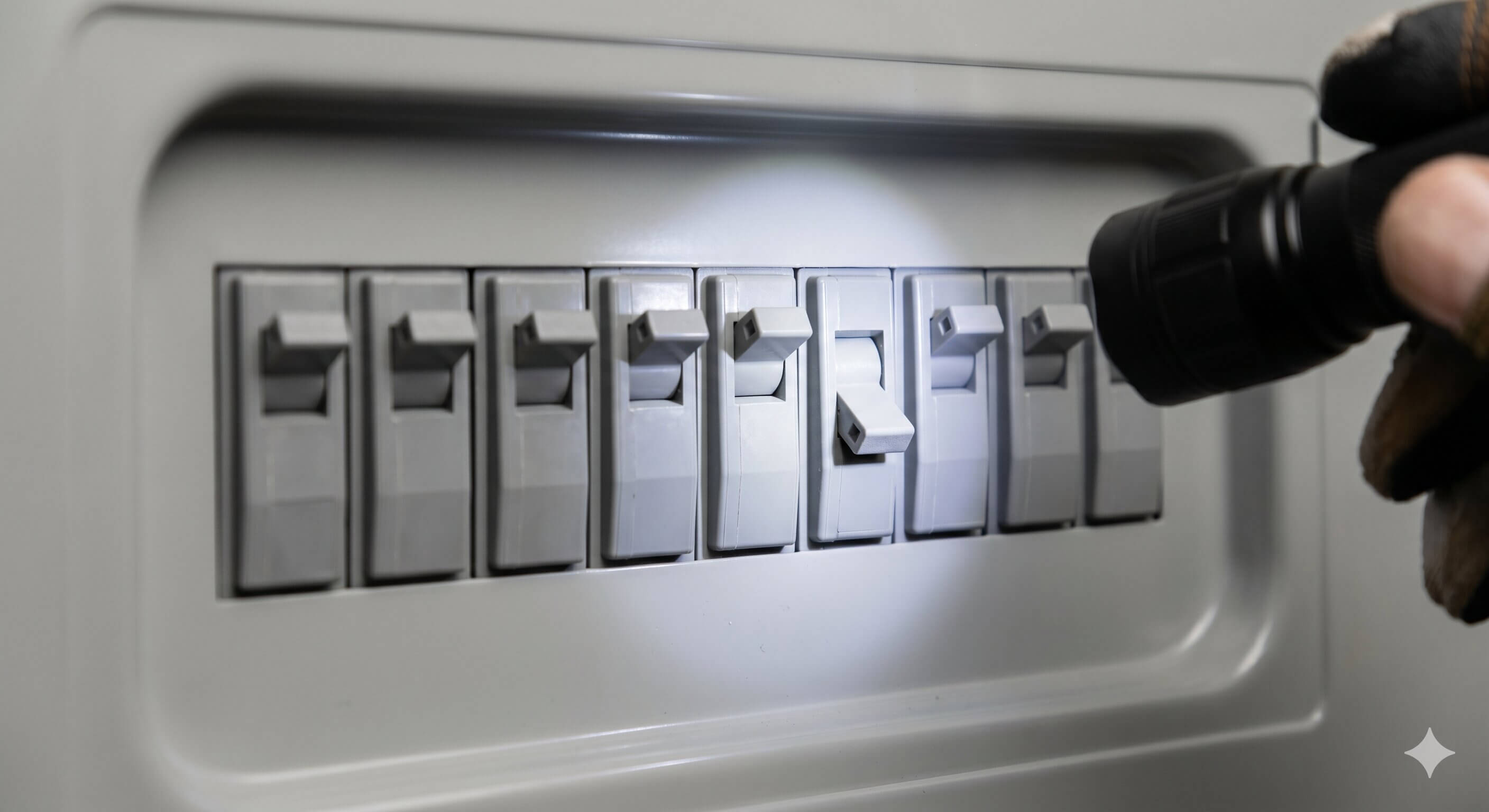
A circuit breaker does not trip without cause — its function is to protect wiring from damage or fire. A breaker that trips repeatedly means there is excess current draw or a short circuit. Do not keep resetting it manually.
Voltage Fluctuations in Abha's Grid
Some Abha districts — particularly elevated neighbourhoods far from main transformer stations — experience more voltage fluctuations than lower-elevation areas. These fluctuations stress PCBs and capacitors, and trigger repeated protective breaker trips.
Electrical Causes of Breaker Trips
1. Struggling or Failing Compressor
A worn compressor draws higher current than normal at startup (Locked Rotor Amperage). This excess current trips the protection breaker. Common at the end of a hot Khamis Mushait summer season.
2. Short Circuit in Wiring
Old or broken wiring inside the unit causes shorts. In outdoor units in Jazan, corrosion from coastal humidity and salt air weakens external wiring over time.
3. Failed Capacitor
A faulty capacitor causes extremely high startup current that trips the breaker. Simple and inexpensive to fix if caught early.
Case — Al-Andalus District, Khamis Mushait
A family called after the breaker tripped three times in two days. We measured compressor current draw and found it pulling 2.3x its normal startup amperage — a compressor on the edge of failure. We replaced the capacitor first, saw significant improvement, and recommended monitoring the compressor through the next summer season.
Frequently Asked Questions
Does replacing the breaker with a larger one fix it?
No — and this is a common, dangerous mistake. A larger breaker allows excess current through, which can burn wiring or start a fire. The root cause must be repaired.
Does hot weather cause breaker trips on its own?
Hot weather stresses the system but does not cause breaker trips by itself. A trip always indicates a genuine technical problem.
How dangerous is an AC that keeps tripping the breaker?
Electrical fire risk is the primary concern. A short circuit inside a wall-mounted unit can ignite the wall cavity or nearby furniture. Immediate repair is necessary.
Is it safe to reset the breaker?
Once, to confirm it wasn't a one-off event. Not repeatedly. The breaker trips because it sees excess current or an earth fault — both are real faults. Repeatedly resetting it overrides the only protective device standing between you and an electrical fire.
What's the difference between tripping instantly and tripping after a few minutes?
An instant trip on start-up suggests a short circuit or earth fault — often a compressor whose insulation has broken down, or damaged wiring. A trip after ten or twenty minutes suggests a gradual overload: a compressor drawing more current than it should, usually from a blocked coil or a weak capacitor.
Can a dirty coil really trip a breaker?
Yes, and it's a link most people don't expect. A blocked coil raises discharge pressure, so the compressor draws more current to work against it. Over time that current exceeds the breaker's rating. Cleaning the coil can resolve what looks like a purely 'electrical' fault.
Could the breaker itself be the problem?
Sometimes. Breakers weaken with age and heat, and a tired one can trip at normal current. But we never assume that before measuring the compressor's draw and its insulation resistance — replacing a healthy breaker while the compressor is failing is a dangerous mistake.
Could the breaker simply be the wrong size?
Yes, and it's common after poor installations. A breaker rated below the unit's requirement will trip under normal summer load. An oversized breaker is more dangerous: it won't trip when it should, which is how a fault becomes a fire.
What should I do until you arrive?
Leave the breaker off and don't run the AC. If you smell burning or see scorch marks around the wiring or the isolator, call us immediately and say so — we treat those as emergencies.
Does your AC need attention?
Call us now for a free assessment and instant quote