
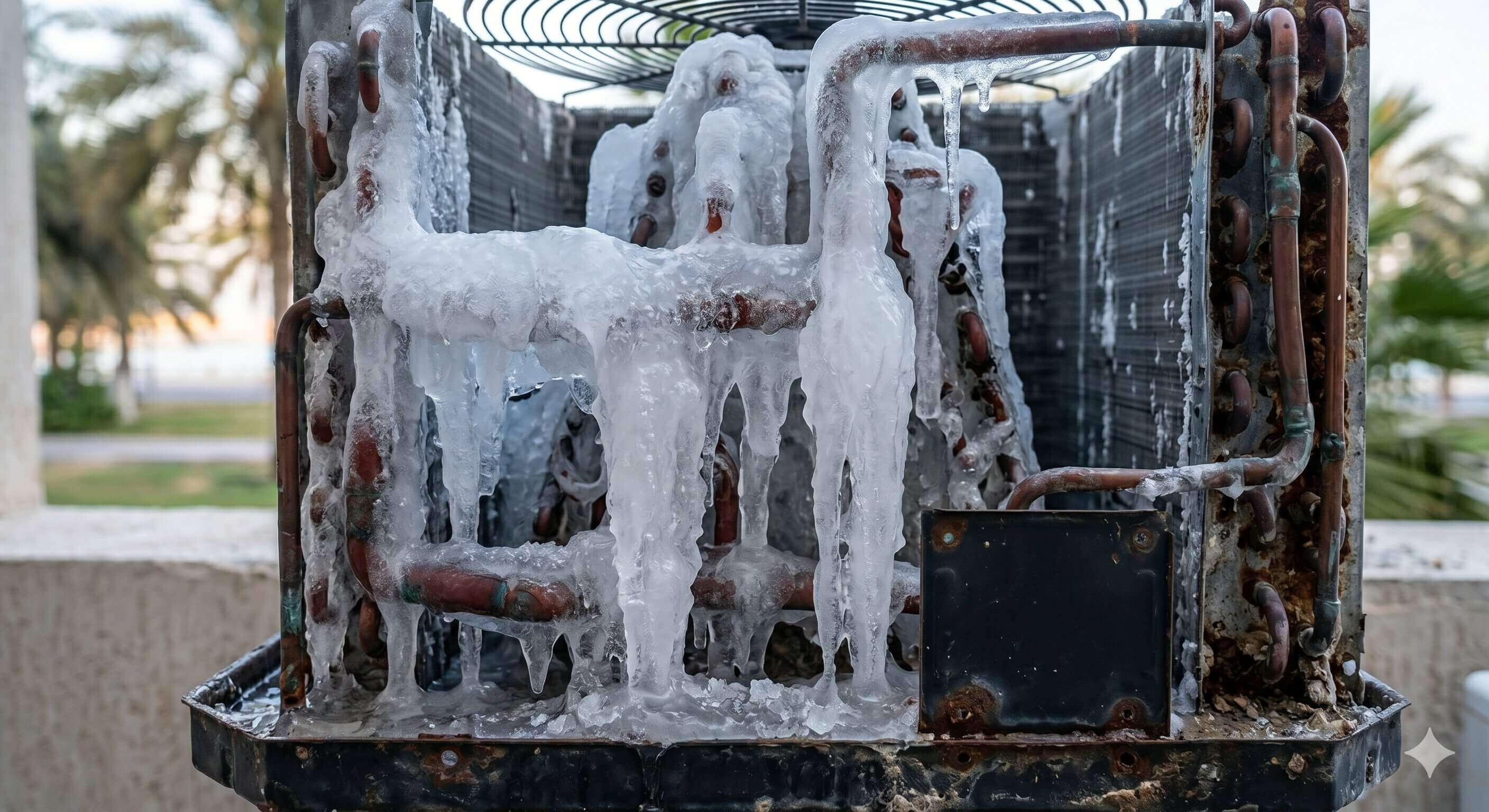
A freezing AC seems contradictory — how does a cooling device freeze? It happens when problems cause the refrigerant pressure to drop below normal or airflow to become blocked. The result: the coil drops below freezing point and moisture crystallises into an ice block.
Why Freezing Is More Severe in Jazan
In Jazan, high humidity means far more moisture condensing on the coil. When the coil gets too cold (from low gas or blocked airflow), this moisture freezes faster and builds ice layers more quickly than in drier climates. A frozen Jazan unit produces more water on thawing and risks ceiling damage.
What to Do Right Now If Your AC Is Frozen
- Switch the AC off at the main breaker immediately
- Do not try to chip or scrape the ice off manually
- Place towels under the indoor unit to absorb thaw water
- Allow it to thaw naturally (2–4 hours), then call us to diagnose the cause
Root Causes of Freezing
Fixing the ice without addressing the cause means it will return. Main causes:
- Low refrigerant — most common, especially in Abha due to altitude-related pressure effects
- Blocked dust filter — common in Abha after the spring dust season
- Indoor fan motor stopped or running too slowly
- Set temperature too low (below 16°C)
- Doors and windows open, constantly returning hot humid air
Frequently Asked Questions
Does a frozen AC mean I need a replacement?
Usually not. Freezing is typically solved by fixing the cause — gas recharge or filter cleaning. Replacement is only necessary if the compressor has failed and the unit is old.
Can an AC freeze in Abha's winter?
Yes. Running cooling mode in very low temperatures (below 10°C) can freeze the outdoor unit. Some modern units have auto-protection against this — we can check if yours does.
What does frozen AC repair cost?
Depends on the cause. Low gas recharge: typically SAR 200–350. Filter cleaning: free. Fan motor repair: typically SAR 250–500.
Why would an AC freeze in the middle of summer?
It seems contradictory but it follows. Freezing happens when airflow across the evaporator coil drops, or refrigerant pressure drops. The coil falls below freezing point, so moisture in the air turns to ice on contact — and the ice insulates the coil further, making it worse. A vicious circle.
What should I do the moment I see ice?
Switch off cooling and run the fan only. That passes warm room air over the coil and thaws the ice faster and more safely than switching off entirely. Never chip the ice off — the coil fins are thin and bend easily, and a punctured tube means a refrigerant leak.
What are the two most common causes?
A blocked filter and low refrigerant. The filter chokes airflow; low refrigerant lowers pressure in the coil. Both end in the same result. Less common causes: a weak indoor blower, a dirty evaporator coil, or closed air vents.
The ice melted and it's cooling again. Is it fixed?
No. Thawing removes the symptom only. If the cause was low refrigerant, the leak is still there and it will freeze again. If it was a filter, it will recur unless replaced. Repeatedly running a freezing system risks liquid refrigerant returning to the compressor — one of the worst things that can happen to it.
Can freezing damage the compressor?
Yes, and that's the real danger. A frozen coil fails to fully evaporate the refrigerant, so liquid returns to the compressor. A compressor is designed to compress gas, not liquid — and liquid does not compress. This is called liquid slugging and it can break a compressor mechanically.
How long does the ice take to thaw?
One to three hours depending on thickness, and faster with the fan running. Don't rush it with a hairdryer or hot water — the sudden thermal change can crack the coil's brazed joints.