
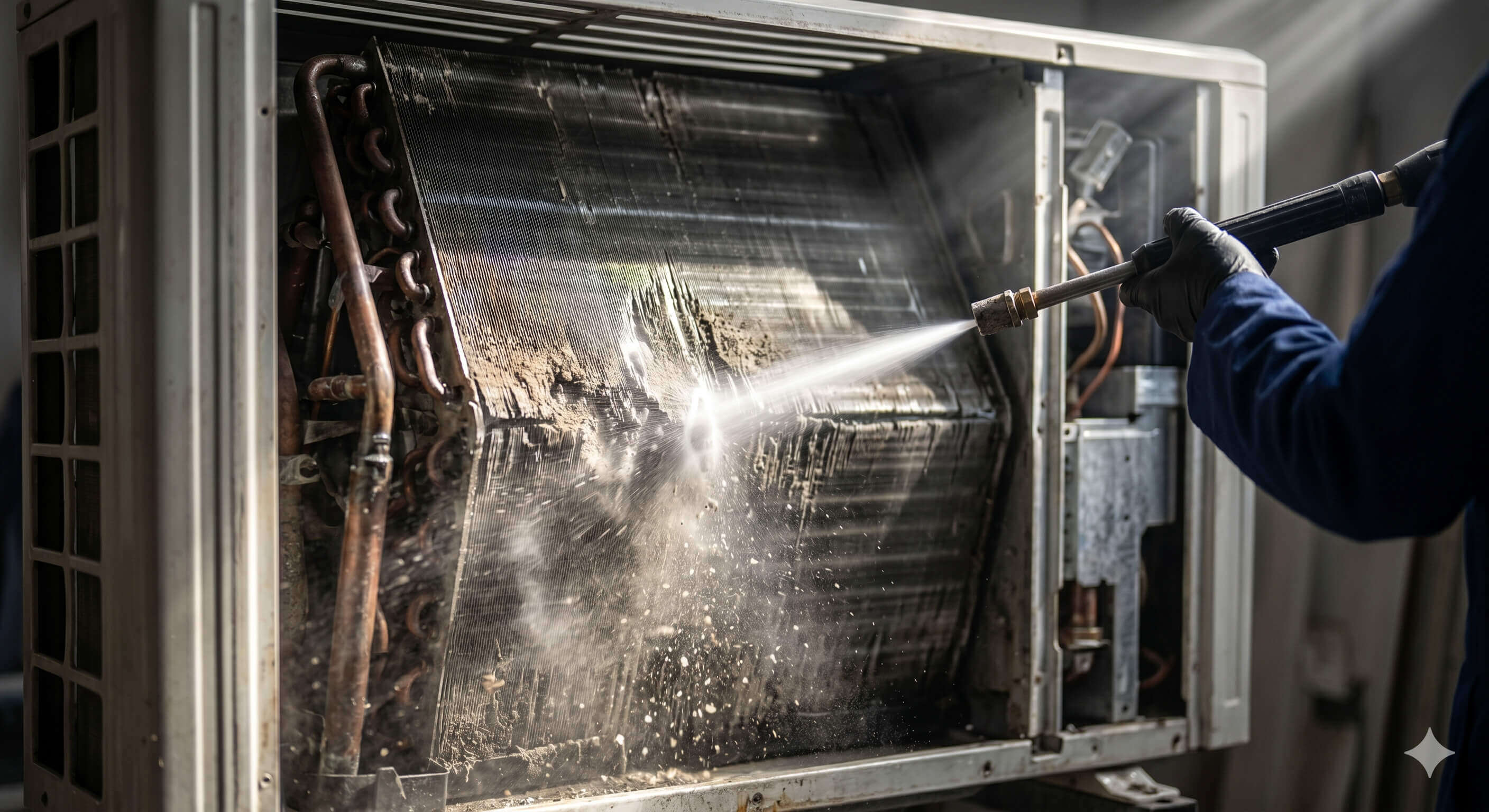
Cleaning an air conditioner in Dammam is not the same operation performed in an inland city. The difference isn't how much dirt there is — it's the state of the surface it lands on.
Inland, dust is dry. On the Gulf, the coil is permanently wet.
That's the whole point. In a dry city, dust settles on a dry coil and can be brushed or rinsed off with relative ease. In Dammam, extreme humidity means the evaporator coil is wet for the entire time the unit runs, and dust arriving on the shamal winds lands on a wet surface.
- Dust on a wet surface turns into a paste, not a layer you can brush away.
- That paste dries and adheres between the fins, and resists a surface rinse completely.
- Which is why "washing" a Dammam AC with a hose from the outside achieves almost nothing. The wash has to be deep, and directed from the inside out, with the right pressure and solution.
And worse: warm + wet + organic matter = a biological reactor
A drain pan holding water all day, a permanently wet coil, and organic dust settling on both — that isn't merely dirt. It is an ideal growth medium for bacteria and fungi.
Which makes AC cleaning in Dammam an air-quality matter before it is an efficiency one. The bad smell at start-up isn't "dust" — it's living growth that the AC then distributes around the room. And it's why washing alone isn't enough: disinfection afterwards is necessary, because washing removes the layer but doesn't kill the spores.
And the volume of water is itself a problem
A high moisture load means an enormous volume of condensate every day. A drain line narrowed by algae and debris will overflow — and overflows in Dammam are far more common than people assume. Usually it's a symptom of a line that hasn't been cleaned, not a fault in the unit.
What our cleaning in Dammam includes
- A deep wash of the evaporator and condenser coils — inside out, not a rinse of the face.
- Full cleaning of the drain pan and condensate line — the most important item in this climate.
- Disinfection after washing — because a wash removes the layer, it doesn't kill what's growing.
- Corrosion inspection on the coil — coastal salt combined with an industrial atmosphere accelerates it, and treating it preventively costs far less than replacing a coil.
- Filters at a higher frequency than standard schedules recommend.
Our Eastern Province team serves Dammam and Khobar on its own number — residential and commercial.
How we clean — the actual steps
- Power isolated, area covered. We wash the unit in place without taking it off the wall, using covers that keep water off your wall and furniture.
- Filters — washed or replaced. In Dammam a filter clogs faster than any standard schedule suggests.
- The evaporator coil pressure-washed from the inside out — because a matted layer will not lift with a rinse of the face.
- The pan and condensate line — fully cleared. This is the most important item in this climate, and the source of most water and odour reports.
- Disinfection — after washing, not instead of it. Washing removes the layer; disinfection kills the spores.
- The outdoor unit — coil washed and corrosion inspected. A clean coil lowers discharge pressure, and that shows up on the electricity bill.
- Dried and run. We don't leave before starting the unit and confirming the cooling is back.
And each type of AC needs a different method
- Split: focus on the indoor unit, pan and drain — that's where the smell comes from.
- Window: a single unit, but its drain is simple and blocks quickly.
- Central and ducted: the problem is usually the ductwork, not the unit. A dirty duct distributes its contents through the whole building.
- Cassette: the condensate pump is what needs checking before anything else.
How to tell your AC needs cleaning
- A bad smell at start-up — that's living growth, not dust.
- Weaker cooling even though the unit is running.
- An electricity bill rising for no obvious reason.
- Water dripping from the indoor unit — the line is blocked.
- Allergies or respiratory symptoms worsening in the room.
A 90-day warranty on our work. We diagnose before we price, and we don't quote a final figure for a fault we haven't seen.