
The most important decision in your AC's life in Dammam is made on the day it's installed, not afterwards. And the most common mistake in this city cannot be fixed by any amount of subsequent servicing: choosing a unit that's too big.
Why "bigger" is wrong specifically in Dammam
Intuition says: it's extremely hot, so pick the larger one. But the Gulf climate isn't merely "hot" — it is hot and very humid. Air above a shallow, warm gulf carries an enormous quantity of water.
Which means your AC spends much of its energy pulling water out of the air rather than lowering its temperature. And the problem is that removing water takes run time, not more capacity:
- An oversized unit drops the temperature quickly → the thermostat is satisfied → it shuts off.
- But it shut off before running long enough to dry the air.
- The result: a room that is cold by the thermometer and damp by feel. You're uncomfortable even though it reads 22°C.
- So you set it lower → shorter, more frequent cycles → a higher bill and a compressor that fails early.
And no servicing fixes this. The wrong size is a permanent mistake. Which is why we calculate the load rather than guess it.
And the outdoor unit's position is effectively irreversible
- Get away from the exposed sea-facing elevation wherever possible — the salt load determines your coil's life more than any specification in the catalogue.
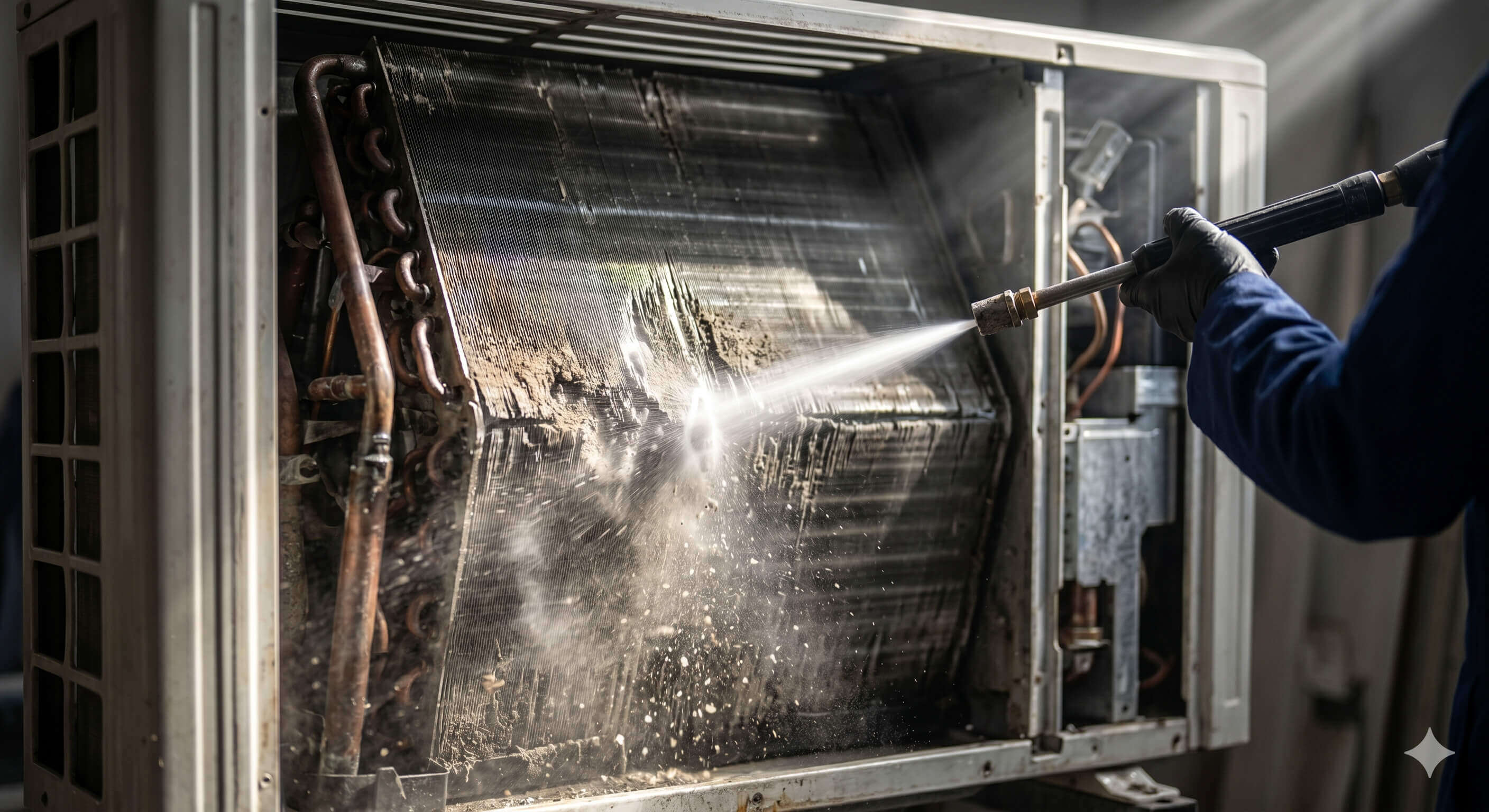
- Leave genuine access for cleaning. A unit whose coil is hard to wash is a unit that won't be washed — and in this climate that's a slow death sentence.
- Avoid direct sun and radiated heat — every extra degree on the outdoor unit raises discharge pressure.
And the drain must be designed for a real volume of water
A high moisture load means a very large amount of condensate daily. A drain with insufficient fall, or too narrow a bore, will overflow within months. In Dammam the drainage has to be designed for that reality, not for a generic table.
What we do when installing in Dammam
- Load calculation — the correct size, not the biggest.
- Outdoor unit siting that weighs salt exposure, sun, and ease of servicing.
- Evacuating the circuit with a vacuum pump before releasing refrigerant — skipping it traps moisture, and moisture plus oil forms acids that destroy the compressor.
- Flare joints formed with the proper tool, and a leak test.
- Charge set by calculation — superheat and subcooling, not guesswork.
- Drainage with correct fall, and a float switch where needed.
Our Eastern Province team serves Dammam and Khobar — residential and commercial, split, cassette, central and VRF.
What our installation includes
- A pre-purchase survey if you want one — we calculate the load and tell you the correct size before you pay for the wrong unit.
- Copper pipework in correct diameters and a calculated length. Extra length changes the required charge, and plenty of people ignore that.
- Fully insulated pipework — and in Dammam's climate this isn't a detail: a poorly insulated pipe condenses water and drips inside the wall.
- Flare joints formed with a proper flaring tool — not with pliers, and not improvised.
- The circuit evacuated with a vacuum pump before the refrigerant is released. Skipping that step seals moisture into the system, and moisture plus oil forms acids that destroy the compressor years later.
- A leak test, then the charge set by calculating superheat and subcooling — not by pressure alone.
- Drainage with correct fall, and a float switch where needed.
- A base or brackets that carry the weight and resist vibration — a loose mounting damages the joints over time.
Which type of AC suits Dammam?
- An inverter makes sense here provided it's correctly sized — continuous running at partial capacity is what dries the air. But it's less forgiving of a neglected coil.
- Corrosion resistance matters more than any efficiency figure on the label. A coated unit will outlast a more expensive uncoated one.
- Coil accessibility is a genuine consideration: a unit that's hard to wash won't be washed.
The mistakes we get called in to fix after someone else's installation
- An oversized unit — a cold, clammy room, a high bill, and a compressor that fails early.
- Evacuation skipped — leaks, acids, and a compressor that dies within a few years.
- Drainage with reverse or insufficient fall — water in the wall.
- Uninsulated pipework — condensation dripping inside the wall.
- An outdoor unit in direct sun with no access space — weaker performance for its entire life.
A 90-day warranty on our work, and genuine OEM parts.