
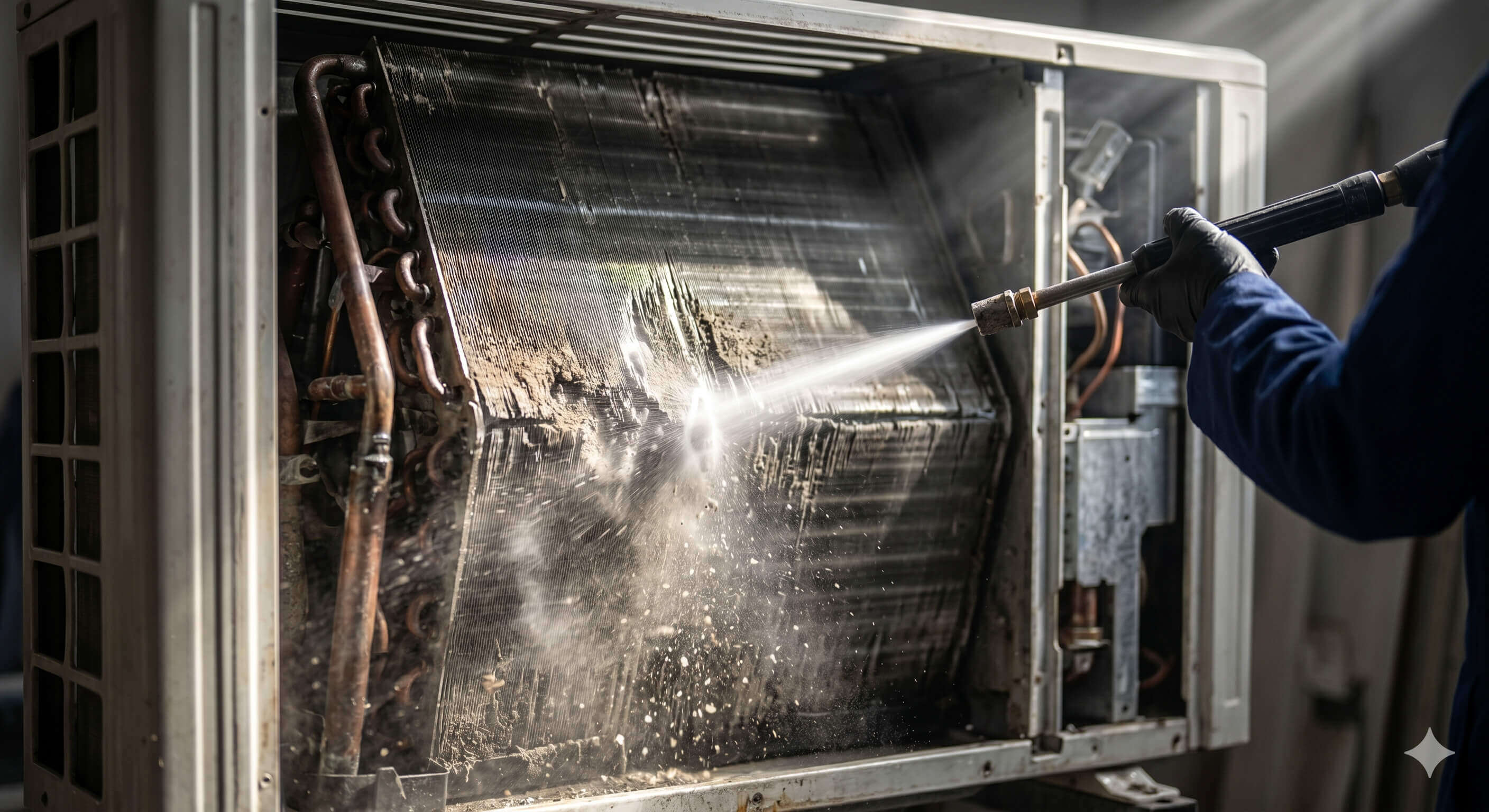
Cleaning an AC in Khobar is governed by three factors that never coincide inland: a permanently wet coil, salt arriving on the sea air, and a volume of condensate that floods drain lines.
A wet coil changes the nature of the dirt
In dry cities, dust settles on a dry surface and can be brushed off. In Khobar, extreme humidity keeps the evaporator coil wet throughout operation — so dust lands on a damp surface and becomes a cohesive layer that adheres between the fins.
A surface rinse with a hose from the outside will not remove it. The wash has to be deep, and directed from the inside out.
And the smell isn't dust — it's living growth
A pan full of water, a wet coil, and warmth: that is a growth medium for bacteria and fungi. The smell that comes out at start-up is what has accumulated on that surface, and the AC is distributing it around your room.
Washing removes the layer. Disinfection is what kills what's growing. In Khobar you don't get to skip the second.
Salt at height
Units on towers and taller buildings facing the Gulf take salt-laden sea air with nothing in the way. Corrosion progressively eats the aluminium fins until they crumble and cooling collapses. Acid washing and a protective coating aren't a luxury here — they're what prevents replacing an entire coil.
Access compounds it: a unit that's hard to reach is a unit that doesn't get cleaned — so it degrades silently.
And the drain line is under real pressure
A high moisture load produces a very large volume of condensate every day. A line narrowed by algae will overflow — and in a high-rise apartment, an overflow means damage extending to the neighbours below you. Cleaning the line is not a secondary item in Khobar.
What our cleaning in Khobar includes
- A deep wash of both coils, directed from the inside out.
- Full cleaning of the drain pan and condensate line, and inspection of the condensate pump and float switch.
- Disinfection after washing.
- Acid washing and an anti-corrosion coating for sea-exposed units.
- Filter checks at a frequency suited to the climate, not to a standard schedule.
Our Eastern Province team serves Khobar and Dammam on its own number — residential and commercial.
How we clean — the actual steps
- Washed in place with covers that keep water off the wall and furniture — no need to remove the unit.
- Filters — washed or replaced at a frequency suited to Khobar's climate, not a generic schedule.
- The coil pressure-washed from the inside out — a cohesive layer on a wet coil won't lift with a surface rinse.
- The pan, drain line, condensate pump and float switch — the most important item in a high-rise, and what prevents damage extending to your neighbours.
- Disinfection after washing — because a wash doesn't kill what's growing.
- The outdoor unit — washed, corrosion inspected, and a protective coating for sea-facing units.
- Run and tested before we leave.
And each type of AC needs a different method
- Split: the indoor unit, pan and drain — the source of the smell.
- Cassette and concealed: common in Khobar's towers — the condensate pump is the first thing checked.
- Central and ducted: a dirty duct distributes its contents through the whole building; the problem is the ductwork, not the unit.
- Window: a simple drain that blocks quickly in this climate.
How to tell your AC needs cleaning
- A musty smell at start-up — living growth, not dust.
- Water dripping or leaking — the line or the pump.
- Weaker cooling from a healthy unit.
- A bill rising for no reason.
- Outdoor fins looking corroded or crumbling — the salt's signature.
A 90-day warranty on our work. We diagnose before we price.