
Installation in Khobar is governed by two realities: an intensely humid Gulf climate, and high-rise buildings. Both make the decisions taken on installation day harder — and more decisive — than they are inland.
Mistake one: an oversized unit
Gulf air is loaded with water to a degree inland cities never experience. Your AC therefore spends much of its energy drying the air — and removing water takes run time, not more capacity.
An oversized unit drops the temperature fast and shuts off before it has dried anything. You get a cold, clammy room, so you set the thermostat lower, worsen the short cycling, and wear the compressor out early. And no servicing fixes a wrong size.
It's also why inverter units perform well in Khobar when sized correctly: continuous running at partial capacity means continuous dehumidification.
Mistake two: drainage not designed for the real volume of water
This is Khobar's particular problem. The high moisture load produces a very large volume of condensate — and in a high-rise apartment, a drain line with insufficient fall doesn't mean a puddle on the floor, it means water tracking into your neighbour's ceiling.
- Correct fall is mandatory, and the shortest practical route is best.
- A float switch — it shuts the unit down before the pan can overflow. In a residential tower this isn't optional.
- In cassettes and concealed units, the condensate pump is the first point of failure — choosing and fitting it carefully saves you very expensive damage.
Mistake three: an outdoor position that kills the coil
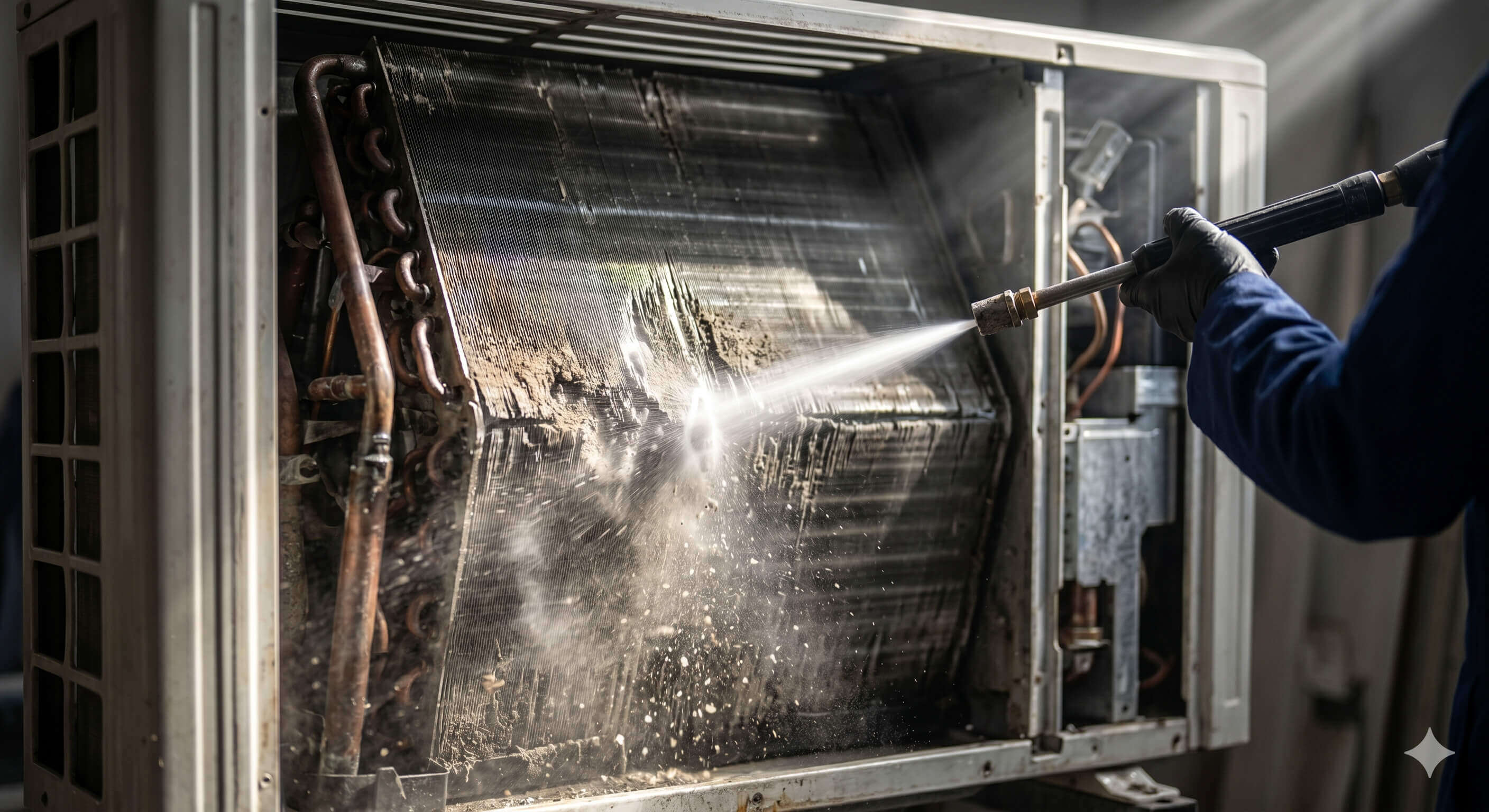
A unit on an elevation facing straight out to sea takes the maximum possible salt load. Wherever it's possible, choose a less exposed position — the difference is measured in years of coil life.
And in taller buildings, access for servicing is a fundamental consideration, not an afterthought: a unit that can't be reached won't be cleaned, and a unit that isn't cleaned in this climate dies early.
What we do when installing in Khobar
- Load calculation and correct sizing — not the biggest.
- Drainage with correct fall, a float switch, and inspection of the condensate pump on cassettes.
- An outdoor position balancing salt exposure, sun, and serviceability.
- Evacuating the circuit with a vacuum pump before releasing refrigerant — no shortcuts.
- Correctly formed flares, a leak test, and the charge set by calculation.
Our Eastern Province team serves Khobar and Dammam — residential and commercial, split, cassette, central and VRF.
What our installation includes
- Load calculation and correct sizing — before you buy, if you want, not afterwards.
- Copper pipework in correct diameters and a calculated length, with the charge recalculated if the run is long.
- Fully insulated pipework — in Khobar's humidity, an uninsulated pipe condenses water and drips into the wall.
- Drainage with correct fall, and a float switch — and in a tower that isn't optional, it's basic protection.
- A condensate pump carefully chosen and fitted in cassettes and concealed units.
- The circuit evacuated with a vacuum pump before the refrigerant is released — no shortcuts.
- A leak test, and the charge set by calculation rather than guesswork.
- A solid mounting that resists vibration, and an outdoor position balancing salt, sun and serviceability.
Which type of AC suits Khobar?
- A correctly sized inverter — continuous running at partial capacity addresses Khobar's primary problem directly: humidity.
- Cassettes are common in towers — but they demand particular care with the condensate pump and its route.
- Corrosion resistance is the leading consideration for sea-facing units, ahead of any efficiency figure.
The mistakes we get called in to fix after someone else's installation
- An oversized unit — a cold, clammy room the owner mistakes for a fault.
- Insufficient drain fall in a high-rise flat — and damage extending to the neighbour's ceiling.
- No float switch — an overflow that a cheap component would have prevented.
- Evacuation skipped — acids, and a compressor that dies early.
- Uninsulated pipework — condensation dripping inside the wall.
A 90-day warranty on our work, and genuine OEM parts.