
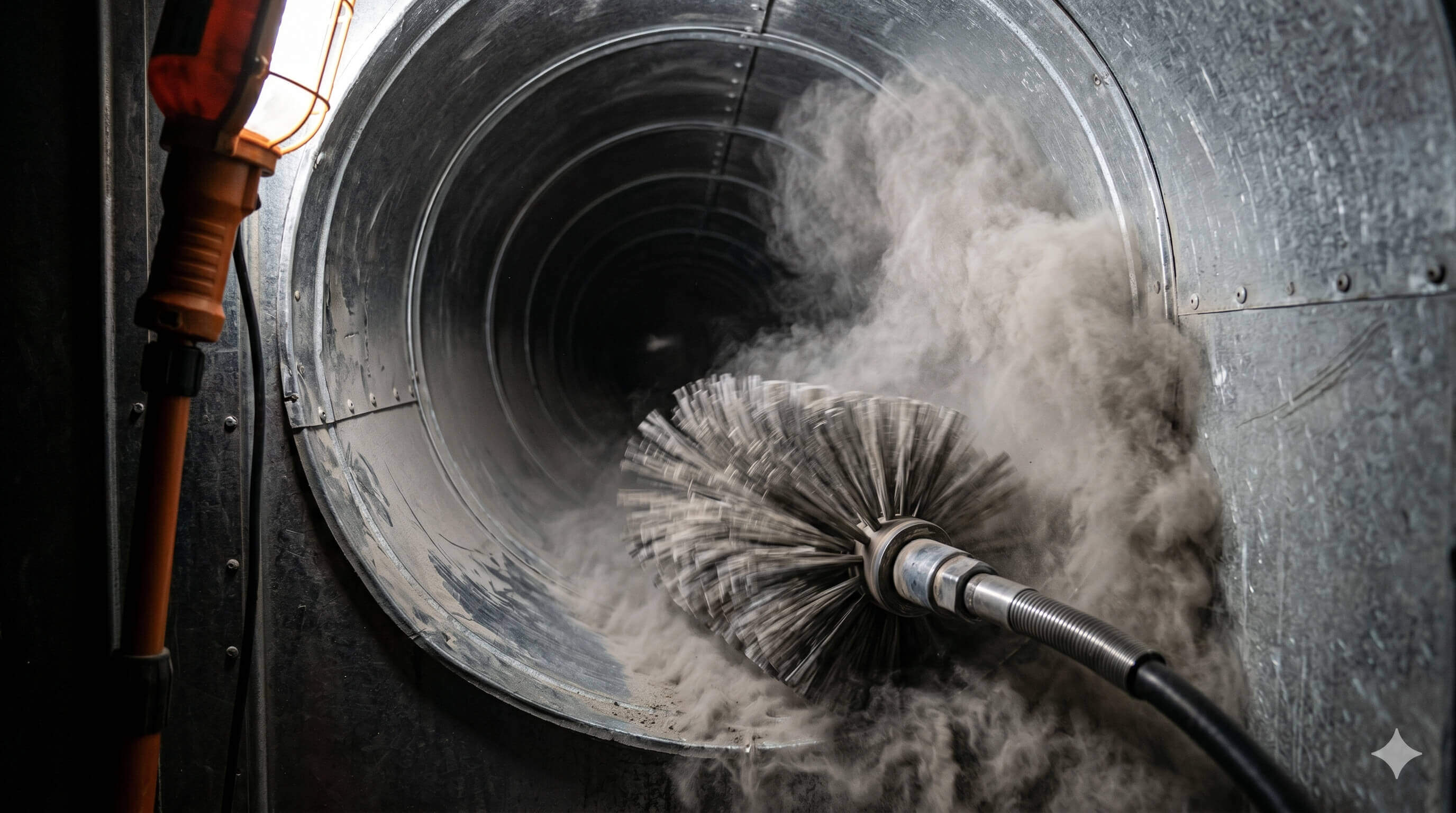
Air duct cleaning is the most misunderstood job in air conditioning. And the right question isn't "how often should I clean them?" — it's: do your ducts need cleaning at all, and what is growing in them, and why?
Why ducts specifically? Because they distribute their contents through the whole house
On a split unit, growth on the coil affects one room. In a ducted system, air travels through the entire network and comes out of every vent in every room. Any biological growth inside a duct is delivered to the whole house.
Which is why a smell coming from your vents isn't a cosmetic problem — it's a signal that something is growing in the air path you breathe.
What actually grows inside a duct?
- Organic dust settling on the internal surface — skin, fibres, pollen, fine food residue.
- Moisture — and this is the key. Dust alone is inert. Dust + moisture + warmth is a growth medium for bacteria and mould.
- And in systems close to the coil, condensate carry-over reaches the start of the duct and keeps it damp.
Which is why ducts in humid climates — Jazan and the Eastern Province in particular — need attention that ducts in a dry city like Khamis Mushait don't.
And the worst problem, which nobody sees: the duct sweats on the outside
This isn't a cleanliness problem but an insulation one — and it ends in mould too.
A duct carries cold air through a hot ceiling void. If the insulation is thin, damaged or open at the joints, the moisture in that void condenses on the duct's outer surface — the way a cold glass sweats.
- The water soaks the insulation, which stops working — so condensation increases. A worsening loop.
- Wet insulation + warmth + darkness = mould, directly above your ceiling.
- Then stains appear on the gypsum — and the plumbing is usually blamed, when the source is the AC system.
So we inspect the insulation and the joints before we talk about cleaning. Cleaning a duct whose insulation has failed treats the symptom and leaves the cause.
When do your ducts genuinely need cleaning?
- A musty or dusty smell from the vents at start-up.
- Dust accumulating unusually fast around the vents.
- Allergy or respiratory symptoms that worsen indoors and ease outdoors.
- Stains or discolouration on the ceiling near the duct run.
- After building or renovation work — construction dust enters the network and stays there.
- Weak airflow from particular outlets.
And when don't they?
We'll say it plainly: not every duct needs cleaning. A modern system, in a dry climate, with filters changed regularly and sound insulation, may need nothing at all. We inspect first and tell you what we found. And we won't recommend work your system doesn't need.
How we clean — and why "vacuuming the vent" isn't enough
Real cleaning doesn't mean pushing a vacuum hose into an outlet. What settles inside a duct adheres to its walls and won't lift with surface suction.
- Inspection first — the internal surface, the insulation, the joints, and the source of any moisture.
- Mechanical agitation of the debris off the duct walls, with extraction under negative pressure so it doesn't disperse into the house.
- Cleaning the coil, blower wheel and pan — because that's usually where the growth originates, and cleaning the duct alone leaves the source.
- Disinfection after cleaning — washing removes the layer, disinfection kills what's growing.
- Sealing joints and repairing insulation where needed — otherwise the condensation and mould come back.
- Airflow measurement afterwards, to confirm performance actually improved.
And an air freshener is not a treatment
Spraying deodoriser into a duct hides the smell and leaves its source growing. We treat the source — or we tell you honestly that the problem isn't in the duct.