
A concealed (ducted) AC differs from a split in one fundamental way: the problem is rarely the unit. The problem is the ductwork — and you can't see it.
A poorly insulated duct sweats on the outside — and destroys the ceiling from above
This is the most serious problem in Dammam, and the most neglected.
The duct carries cold air through a ceiling void that is hot and very humid. If the insulation is thin, damaged, or open at the joints, the moisture in that void condenses on the duct's outer surface — exactly the way a cold glass sweats.
- The condensed water soaks the insulation itself, which then stops working — so more condensation forms. A worsening loop.
- Wet insulation, warm and dark, is a growth medium for mould — directly above your ceiling, where you never see it.
- Then ceiling stains appear — and are usually blamed on plumbing, when the source is the air conditioning.
Which is why the first thing we inspect on a concealed system in Dammam is the duct insulation and the tightness of its joints, not the unit.
And the smell doesn't stay in one room — it's distributed through the whole building
On a split, growth on the coil affects one room. On a concealed system, the airstream travels through a duct network — so any biological growth inside the ducts or on the coil is delivered to every outlet in the house.
The inside of a duct is dark, may carry organic dust, and meets humid air. Which makes duct cleaning in this climate anything but a luxury — and explains why the most-searched issue in the region is duct smell, not duct efficiency.
Static pressure: the wrong ductwork defeats the best unit
If the ducts are undersized, too long, full of sharp bends, or leaking at the joints, the unit works against more resistance than it was designed for.
- Less airflow from every outlet, and distant rooms that never get cold.
- The unit runs longer and consumes more to deliver less.
- And the evaporator coil can freeze from poor airflow — which the owner mistakes for low refrigerant, tops it up, and makes worse.
A leaking duct in a hot ceiling void is worse still: you're air-conditioning the roof space and paying for it.
And the condensate pump — there's no gravity here
Unlike a split, a concealed unit usually needs a condensate pump, because it sits in the ceiling. The pump is the first point of failure, and when it fails the pan overflows inside the gypsum ceiling — damage you only discover after the ceiling is ruined. A float switch is what prevents that.
Our concealed AC services in Dammam
- Inspection of duct insulation and joint sealing — the leading cause of ceiling damage in this climate.
- Duct cleaning and disinfection, treating odour at its source rather than masking it.
- Static pressure and outlet airflow measurement, and relief of restrictions.
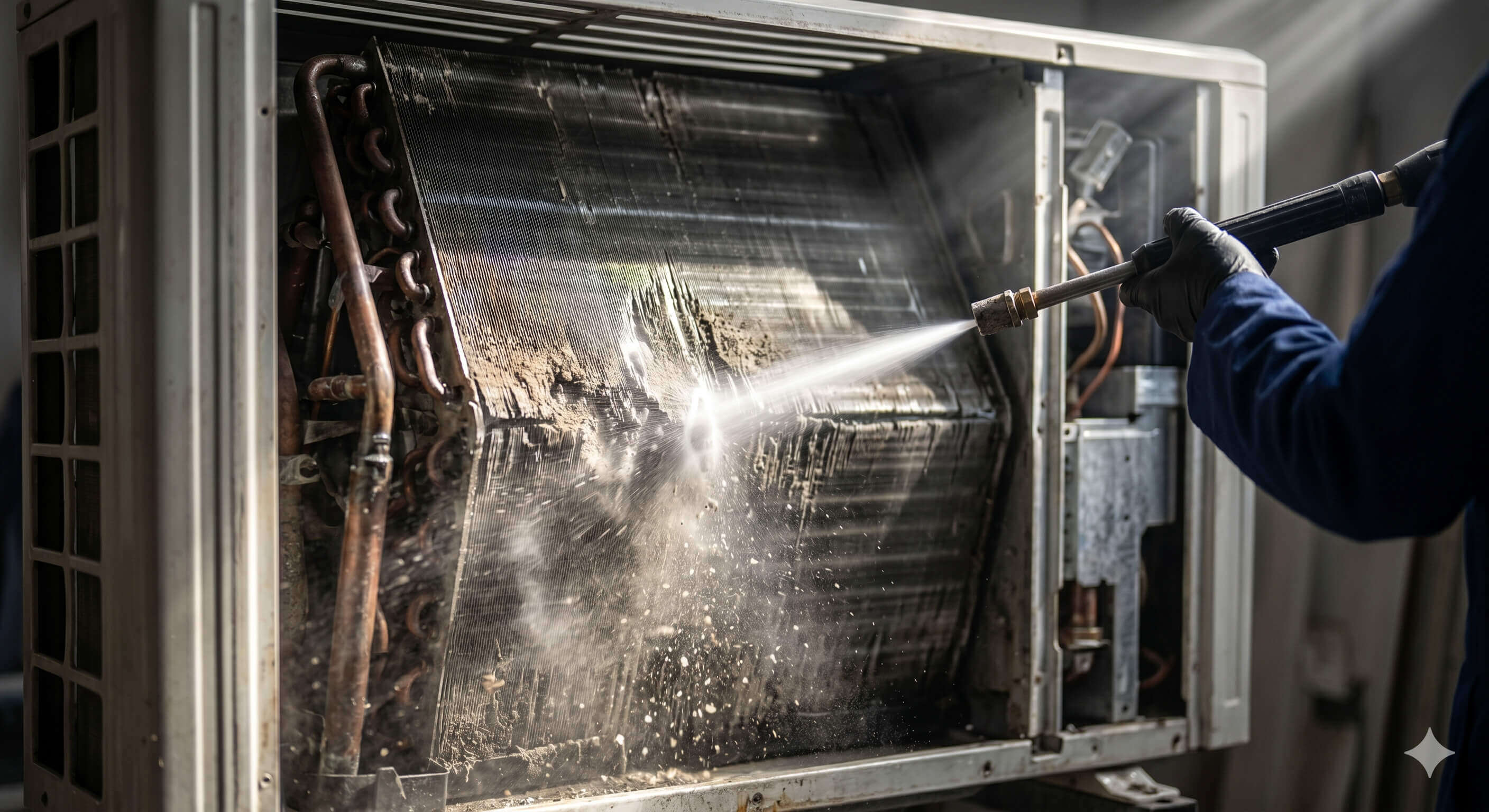
- Washing the coil, blower wheel and pan, followed by disinfection.
- Inspection of the condensate pump, float switch and drain route.
- Repair and rehabilitation of duct networks.
A 90-day warranty on repair work. We diagnose before we price.